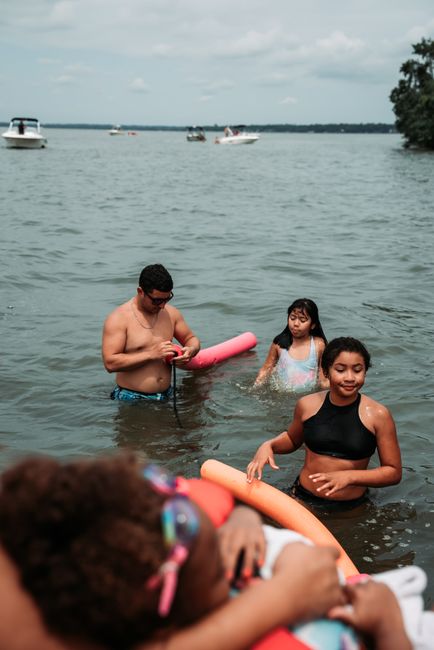
Part of the magic of a day on a floating island is the water itself: clear coves, quiet shorelines, fish under the mesh seats. Keeping it that way is on all of us. This guide explains what inflatable floating islands are made of and how they work, then gives you an honest picture of what makes a sustainable floating island habit: buying well, caring for it so it lasts, repairing instead of replacing, and leaving no trace on the water.
What inflatable floating islands are made of
Almost every party island on the market is built from PVC (vinyl), a tough, waterproof plastic that holds air well and can be welded into big shapes. What separates one island from another is how thick that PVC is and how it’s put together.
PVC thickness and coatings
Makers describe thickness as gauge. Among the islands in our buying guide, the Aqua 11′ x 8′ Raft uses 20-gauge PVC and the Intex Splash ‘N Chill uses 18.2-gauge PVC. Bestway uses its own Inflata-Shield vinyl, and Airhead uses reinforced PVC. Some islands add a fabric top, like Aqua’s Cozi-Soft cooling fabric, which stays cooler on bare legs than plain vinyl.
Seams, chambers and valves
- Seams: panels are joined by heat or radio-frequency (RF) welding. Airhead builds its islands with RF-welded seams. Seams are where most wear shows up, so they’re the first place to check.
- Air chambers: a big island isn’t one balloon. Outer tubes, backrests and inner sections are often filled separately, and the Airhead Fiesta Island adds a central air chamber for support.
- Valves: Boston valves and Airhead’s Speed Safety Valve let you inflate and deflate quickly with a pump.
- Mesh: mesh seats and floors let water through so you sit half in the lake, which keeps you cool.
How a floating island floats and stays stable
The idea is simple: lots of air in a wide, low shape. The air chambers carry the weight, and the wide footprint keeps the island from tipping when people shift around or climb on from one side.
- Wide and low beats tall. That’s why ring islands and flat rafts feel steady even with a crowd.
- Firm air matters. An underinflated island sags at the edges. Top it off once it’s in cool water, since air shrinks as it cools.
- Weight limits are real. Each maker sets its own, and some don’t publish one. Go by the lowest figure you can find and don’t overload it.
- Wind is the weak spot. A light, flat island catches wind like a sail, especially with a shade up. Tie it off well and stay off it in strong wind, storms or current.
An honest look at the sustainable floating island
Let’s be straight: PVC is a plastic, and an inflatable island is not biodegradable. You’ll see big green claims online, but unless a maker states something specific about a product, treat them with care. The good news is that how you buy and use an island makes a real difference.
- Buy once, buy right. Choose a size that fits your crew and a sturdy build, so you don’t end up buying a second island next summer.
- Make it last. The greenest island is the one you keep using for many seasons. Care and storage (below) do most of the work.
- Repair, don’t replace. Most leaks are small pinholes or valve issues that a patch kit fixes in minutes.
- Pass it on. An island you’ve outgrown can go to a friend, a camp or a resale group.
- Dispose of it properly. When it’s truly done, check whether your town accepts PVC for recycling. If not, put it in the trash, never leave it at the lake.
Care that keeps your island out of the landfill
Keep it out of the sun when you’re not on it
Sun and heat are hard on vinyl over time. Bring the island in at the end of the day instead of leaving it on the water or baking on the dock, and dry it in the shade.
Clean gently
Rinse off lake water, salt, sand and sunscreen with fresh water. For dirt, a soft cloth and mild soap are enough. Skip harsh solvents and stiff brushes that can wear the surface.
Patch small leaks early
- Find the leak with soapy water: look for bubbles.
- Deflate, clean and dry the area.
- Apply the patch from your repair kit as its instructions say and let it cure fully before you inflate.
- If the leak is at a seam or valve, check the maker’s warranty or contact them before you patch.
Store it dry
Let it dry completely before folding so it doesn’t mildew, fold it loosely, and store it indoors away from heat, sharp objects and rodents.
Leave no trace on the water
- Anchor with care. Drop the anchor bag on sand or mud, not on seagrass, reefs or plant beds.
- Nothing goes overboard. Bring a trash bag, use cups with lids, and keep wrappers and cans in the cooler until you’re back.
- Clean, drain and dry between lakes. Rinse and fully dry the island, lines and anchor bag before you take them to another body of water, so you don’t carry plants or critters with you.
- Give wildlife room. Set up away from nesting birds and quiet shorelines, and keep the music at a level the neighbors won’t mind.
- Stay safe too. Kids and weak swimmers wear life jackets, an adult keeps watch, and floats stay well away from boat traffic. More in our inflatable island safety tips.
Durable islands worth keeping for years
If you want an island that lasts, these two from our floating island comparison stand out for their build.
Aqua 11' x 8' Raft with Docking Lounge
- 6–7 people
- 1,540 lb limit
- Detachable lounger
Airhead (Sportsstuff) Fiesta Island
- 1–8 people
- 16 qt floating cooler
- 11.5 x 11.5 ft
- Aqua 11′ x 8′ Raft with Docking Lounge: 20-gauge PVC with a Cozi-Soft fabric top, rated by the maker for 6 to 7 people and 1,540 lb. Note the maker’s warranty is only 60 days, so care matters.
- Airhead Fiesta Island: reinforced PVC with RF-welded seams and a central air chamber, from a maker of towable tubes. It’s the priciest island in our guide, built for crews who use it every weekend.
Check the Airhead Fiesta Island price on Amazon
Ready to set yours up? Our inflatable island setup guide covers inflating, anchoring and layout. See all our floating island guides.
Sustainable floating island questions
What are inflatable floating islands made of?
Mostly PVC (vinyl) in different thicknesses, joined with welded seams. Many add mesh seats or floors, and some add a fabric top. Check the product listing for the gauge and build.
Are inflatable floating islands eco-friendly?
They’re plastic, so not inherently. What helps most is buying one that fits your needs and lasts, caring for it, repairing small leaks, and recycling it where your town accepts PVC.
Are inflatable islands biodegradable?
No. Standard PVC islands don’t break down in nature, which is why they should never be left at the lake. Only trust a biodegradable claim if the maker states it clearly for that product.
How do you make a floating island last longer?
Keep it out of the sun when you’re not using it, rinse it with fresh water, let it dry fully before folding, store it indoors, and don’t overload it.
Can you recycle an old inflatable island?
Sometimes. Some recycling programs take PVC and many don’t, so check with your town. If it still holds air, giving it away is even better.