This article contains affiliate links: if you buy through them we may earn a commission, at no extra cost to you. Read our affiliate disclosure.
You’ve found the perfect cove: glassy water, a sandbar for lunch, friends rafted up off the stern. It looks deep enough. But the water that’s perfect for standing around with a drink is exactly the water a slide shouldn’t land in. Before the first rider goes, the boat slide water depth under the end of the slide, and the open space around it, decide whether the afternoon is fun or a trip to the clinic.
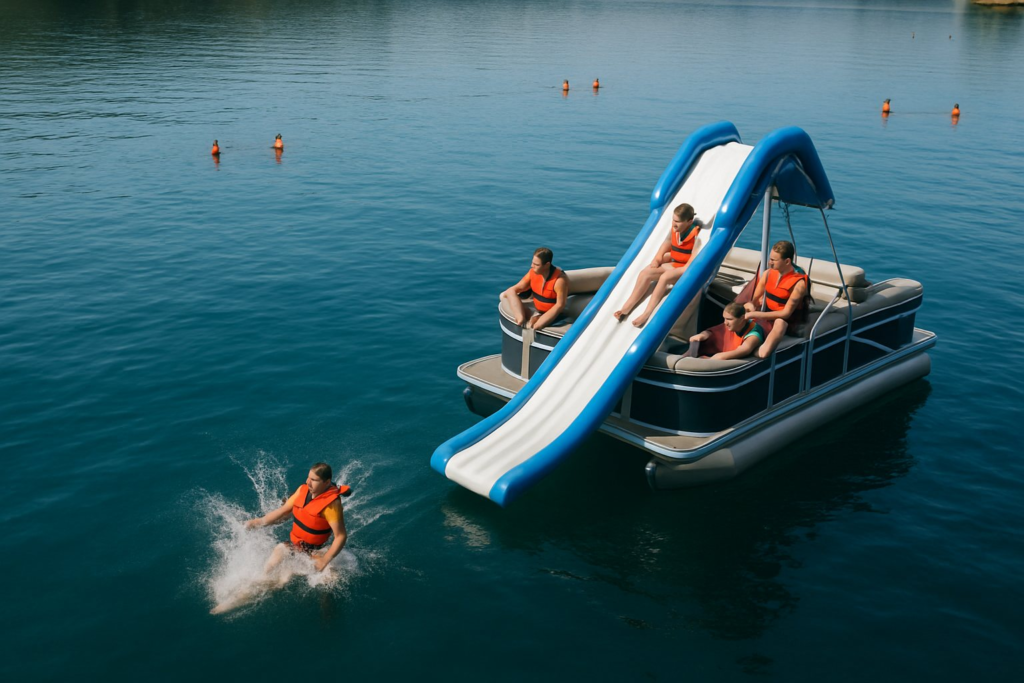
In short: follow the depth your slide’s maker states. RAVE says its pontoon slide “must be in minimum five feet of water.” A review site reports 8 ft of depth and 10 ft of clear space from the boat for Aquaglide’s pontoon slide. If your slide’s maker publishes nothing, check the manual, measure the actual depth at the landing spot, and keep a wide, clear landing zone with one rider at a time.
Boat slide water depth: what makers and reviewers say
Only a few slide makers publish a depth on their product pages. Here’s what we found, with who said it. A figure from a review site is labelled as such, because it isn’t the maker’s own statement.
| Slide | Water depth | Space from the boat | Who says so |
|---|---|---|---|
| RAVE Pontoon Slide | Minimum 5 ft (1.5 m) | Not published | RAVE (maker) |
| Aquaglide Freefall Pontoon Slide (discontinued) | At least 8 ft (2.4 m) | At least 10 ft (3 m) | Lake Lubbers (review site) |
| RAVE Dock Slide (discontinued) | At least 48 in (1.2 m), “preferably much more” | Not published | Lake Lubbers (review site) |
| Airhead Spillway | Not published on the product page | Not published | Check the manual |
| Yacht slides (FunAir, Yachtbeach) | Not published on the product pages | Not published | Used at anchor in open water; ask the maker |
The spread is wide, from 4 ft to 8 ft, and different slides have different heights and exit angles, so one slide’s figure doesn’t transfer to another. If you have the slide in hand, the owner’s manual is the place to look. If the manual doesn’t say, ask the maker; don’t assume the smallest number you’ve seen applies to yours.
How to check the depth where you are
- Anchor first, then check. Boats swing on anchor, so check once the boat has settled.
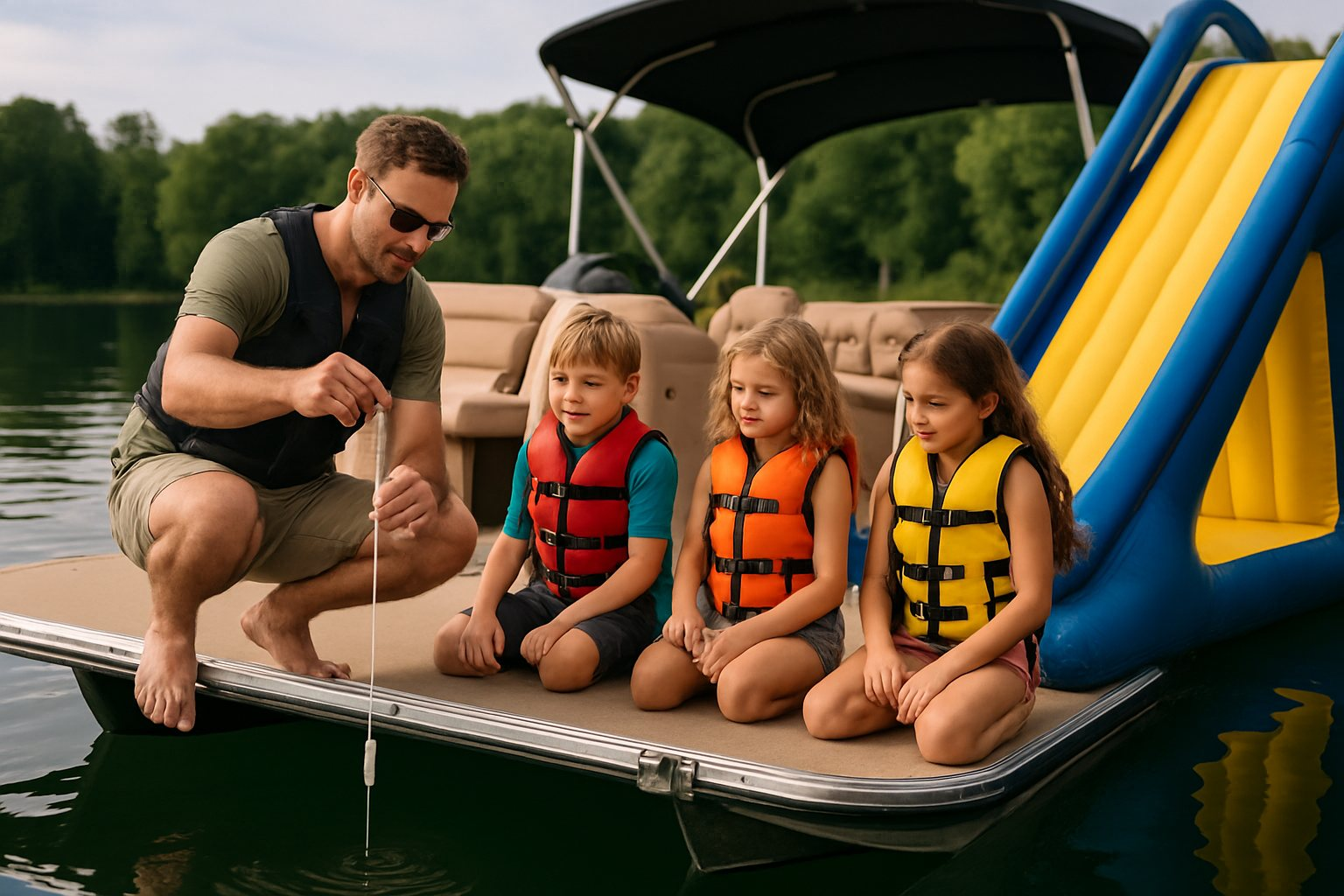
- Read the depth at the landing spot, not under the helm. Your depth sounder reads under its transducer, which may be at the other end of the boat from the slide. A weighted line dropped where riders will land tells you what’s actually there.
- Look for what’s on the bottom. Rocks, stumps, weed beds and sandbars can sit higher than the average depth. On a lake you know, ask around; on a new one, look before anyone jumps.
- Watch the water level. On tidal water or a dam-controlled lake, depth changes during the day. Check again if you stay for hours.
The landing zone and clearance
Depth is only half of it. The landing zone is the stretch of water where riders come off the slide and swim back. Keep it clear of:
- Swimmers. One rider at a time, and the next rider waits until the last one has swum clear. Pontoon slide makers rate their slides for one rider up to 200 lb.
- Floats, toys and anchor lines. Move tubes and floats away from the slide’s path, and know where your anchor line runs.
- Other boats. Fly a diver-down or swimmers-in-the-water flag where local rules call for one so passing boats know people are in the water.
- Engines and exhaust. Engine off and keys out before anyone slides. The US Coast Guard warns never to sit or hang on the back deck or swim platform “while the engines are running,” because of carbon monoxide near exhaust outlets.
The review-site figure of 10 ft of space for the Aquaglide pontoon slide gives a sense of scale: the landing zone is bigger than the slide. On a yacht, Fraser describes slides being set up only “when your yacht anchors in calm, protected waters,” with the captain assessing conditions and crew supervising, and that’s a good rule anywhere.
Wind, waves and age
We looked for wind limits and minimum ages from FunAir, Yachtbeach, RAVE and Airhead and found none; no boat slide maker publishes either. Use common sense and the conditions on the day: if the boat is swinging, the water is choppy or a storm is building, the slide comes down. For children, adult supervision and a spotter are the rule we see repeated by everyone from charter brokers to retailers.
Pontoon slides with a published depth
If a stated depth matters to you, the RAVE is the one with a maker figure on its product page. The Spillway is the sturdier build on paper (1,000-denier PVC). Prices seen on Amazon in October 2026: RAVE about $320, Spillway about $605.
RAVE Sports Pontoon Slide
- 9 ft slide
- 200 lb rider limit
- 12V inflator included
Airhead Spillway Pontoon Slide
- 8 ft sliding surface
- 200 lb, one rider
- Pump not included
Airhead Spillway pontoon slide
by Airhead (SportsStuff)
- Size (as stated): 10.5 x 2.75 x 4.5 ft; 8 ft slide
- Stated capacity: 200 lb rider limit
Aquaglide Freefall Pontoon Slide
by Aquaglide
- Size (as stated): 116 x 37 x 62 in
- Stated capacity: 200 lb rider limit
Bennington Top Deck slide (factory option)
by Bennington
- Stated capacity: Upper deck rated 4 people / 585 lb
O’Brien Pontoon Slide
by O'Brien
- Size (as stated): 105 in L x 24 in W x 70 in H
- Stated capacity: 200 lb rider limit
RAVE Dock Slide
by RAVE Sports
- Size (as stated): 9 ft slide
- Stated capacity: 200 lb rider limit
RAVE Pontoon Slide
by RAVE Sports
- Size (as stated): 10 ft L x 25 in W x 68 in H; 9 ft slide
- Stated capacity: 200 lb rider limit
If you’d like a calm place for riders to climb out and rest after the landing, a boat swim platform tied off the stern can help; InflatablePlatforms covers them in its boat swim platforms guide. Keep it well out of the slide’s landing path.
Water depth questions
How deep should the water be for a pontoon slide?
Use your slide’s figure. RAVE states a minimum of 5 ft for its pontoon slide; a review site gives 8 ft for the Aquaglide Freefall. If your slide’s maker doesn’t publish one, check the manual or ask the maker.
Is a dock slide different?
The same rule applies, but docks are often in shallower water near the shore. A review site gave at least 48 in for the RAVE Dock Slide, “preferably much more.” Measure at the end of the slide, not at the end of the dock.
Can riders go head first?
Retailer safety guidance is one rider at a time, feet first. Follow the instructions printed on your slide.
Is there a wind limit?
No maker publishes one. Use the slide only in calm water at anchor, and take it down when conditions change.
Back to Fit & Sizing. More: will a slide fit my boat?, boat slide safety tips and our setup and safety hub.