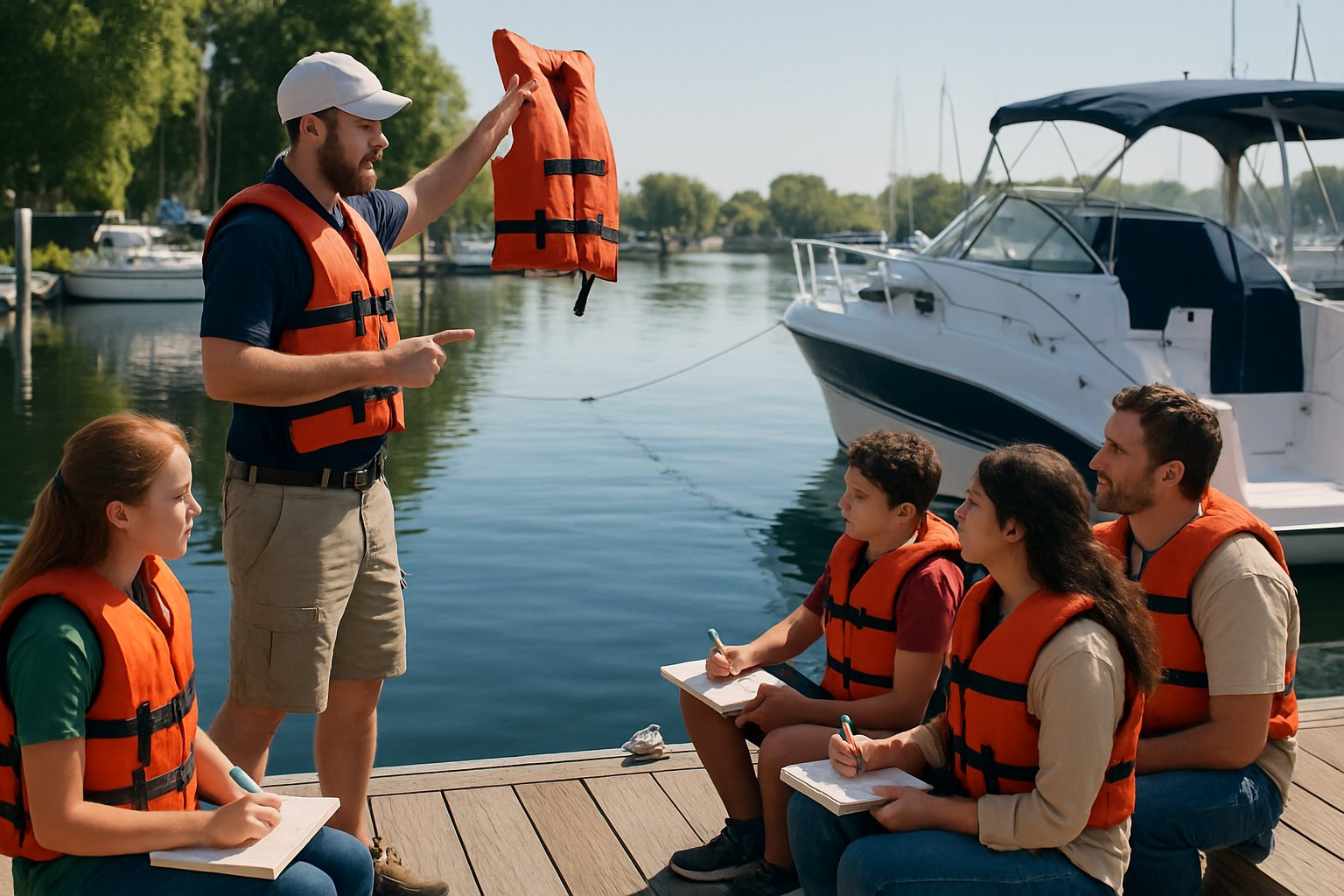
Your nephew is 19, just back from college, and he wants to take the pontoon out with his friends and the slide. He’s driven a car for years. Can he drive the boat? In many states the answer depends on his birth date, the size of the engine and a small plastic card. Boater education requirements by state are the rules that decide who may operate a boat, and they sit on top of the federal equipment rules. Here’s how they work in general, where to find your state’s, and what changes when someone wants to charge passengers for a ride.
In short: boating education is set by each state, not by the Coast Guard. Many states require operators born on or after a certain date to carry a boating education card from an approved course, often only for motors above a set horsepower. Courses are approved by the states, and NASBLA approves courses that meet the national ANSI/NASBLA standard; some states, such as Florida, accept cards from other states’ NASBLA-standard courses. Carrying paying passengers is a different matter: it needs a Coast Guard credential, such as the OUPV (“six-pack”) endorsement for up to six passengers.
Why boater education matters
The Coast Guard’s Recreational Boating Statistics 2024 found that, where instruction was known, 69% of deaths in 2024 happened on boats whose operator had not received boating safety instruction, and only 19% on boats whose operator had a nationally approved boating safety education certificate. Operator inattention, improper lookout and operator inexperience were the top three primary contributing factors in incidents. A course covers exactly those: navigation rules, lookout, required equipment, and how to handle the boat with people in the water.
NASBLA-approved boating courses
NASBLA, the National Association of State Boating Law Administrators, approves courses that meet the ANSI/NASBLA Basic Boating Knowledge standards (ANSI/NASBLA 100-2022 Core and 103-2022 Plus Power, effective June 1, 2022). A course provider with a NASBLA-approved course then submits it to each state’s boating agency for that state’s approval. In practice, look for a course approved by your state; that’s what earns the state’s card.
Where to take one: the Coast Guard lists course providers including the U.S. Coast Guard Auxiliary (local flotillas), America’s Boating Club (U.S. Power Squadrons), the BoatUS Foundation (free online courses with certification options in many states), state boating agencies, and several online providers with state certification tests. The Coast Guard says the most popular basic courses run from 6 to 13 lessons.
Boater education requirements by state: how they work
States write these rules in different ways. The common patterns:
| Pattern | What it means |
|---|---|
| Born on or after a date | Operators born on or after the state’s cut-off date need a card; older operators may not. |
| Horsepower threshold | The rule applies only above a set engine size. |
| Personal watercraft rules | Separate or stricter education and age rules for PWC. |
| All ages | Some states require education for every operator. |
| Rentals or certain ages only | Narrower rules in some states; a few have no requirement. |
An example from state law: in Florida (s. 327.395), anyone born on or after January 1, 1988 may not operate a boat with a motor of 10 horsepower or more without photo ID and a Florida boating safety identification card or an accepted equivalent on board. Florida accepts a card from another state, a U.S. territory or Canada if the course meets NASBLA’s minimum standards. Florida’s law also lists what every course must teach, including the danger of operating with a person in the water near the boat and of passengers riding on the bow, gunwales or transom.
NASBLA publishes a summary table of state education laws, but it notes the information was believed current as of January 1, 2016 and tells boaters to check with the state boating authority. So do exactly that: find your state in the NASBLA state boating agency directory. The Coast Guard’s own guide points boaters to the same directory for education and operator rules.
Boating in another state
- Education: some states accept a card from a NASBLA-standard course issued elsewhere; Florida’s law is one example. Check the state you’ll be boating in.
- Registration: under federal rules, a state certificate of number stays valid for 60 days after a boat moves to a new state of principal use. After that, register in the new state.
- Equipment and children: life jacket ages, flag rules and BUI limits follow the waters you’re on. See life jackets on boats and boating under the influence.
Carrying paying passengers: the commercial line
A state boating card is for recreational operators. Once someone pays to ride, federal rules for passenger vessels apply. At a high level:
- Up to six passengers for hire: a self-propelled uninspected passenger vessel must be under the direction and control of someone holding a Coast Guard merchant mariner credential endorsed as Operator of Uninspected Passenger Vessels, OUPV, often called the “six-pack” license (46 CFR 15.605). The OUPV endorsement covers vessels under 100 gross tons carrying six or fewer passengers and, for most routes, requires at least 12 months of experience operating vessels (46 CFR 11.467).
- More than six passengers, at least one for hire: the boat generally falls under the Coast Guard’s small passenger vessel rules (46 CFR Subchapter T), with inspection requirements for the vessel and higher credentials for the operator.
- Equipment: uninspected passenger vessels also carry extra equipment beyond the recreational list, for example visual distress signals on coastal waters regardless of length.
Who counts as a passenger, what counts as “for hire” and how charters are structured are defined in federal law and regulations (33 CFR 175.3 has one definition of passenger), and the details matter, so talk to your local Coast Guard sector or a maritime attorney before you charge anyone. This is a summary, not legal advice. If you run charters or tours with a slide, our page on charter and excursion boats covers the commercial slide side, and you can request more information about commercial slides.
Boater education questions
Do I need a license to drive a boat?
For recreational boating, the Coast Guard sends boaters to their state for education and operator requirements. Many states require a boating education card, often based on birth date and engine size, so check your state’s agency. Carrying paying passengers needs a Coast Guard credential.
Is a boating safety course online accepted?
Many states approve online courses; the Coast Guard lists several online providers with state certification tests. Make sure the course is approved for your state.
Does my boating card work in other states?
It depends on the state you visit. Florida’s law, for example, accepts cards from other states’ courses that meet NASBLA standards. Confirm with the state you’re visiting.
Can I charge friends gas money for a boat ride?
Whether a payment makes someone a passenger for hire is a legal question the Coast Guard decides on the facts. Ask your local Coast Guard sector or a maritime attorney before accepting money.
What’s an OUPV or six-pack license?
A Coast Guard endorsement as Operator of Uninspected Passenger Vessels, for boats under 100 gross tons carrying six or fewer passengers, at least one of them paying.
Back to the boat safety hub. Related: the Coast Guard equipment checklist and boating under the influence.