This article contains affiliate links: if you buy through them we may earn a commission, at no extra cost to you. Read our affiliate disclosure.
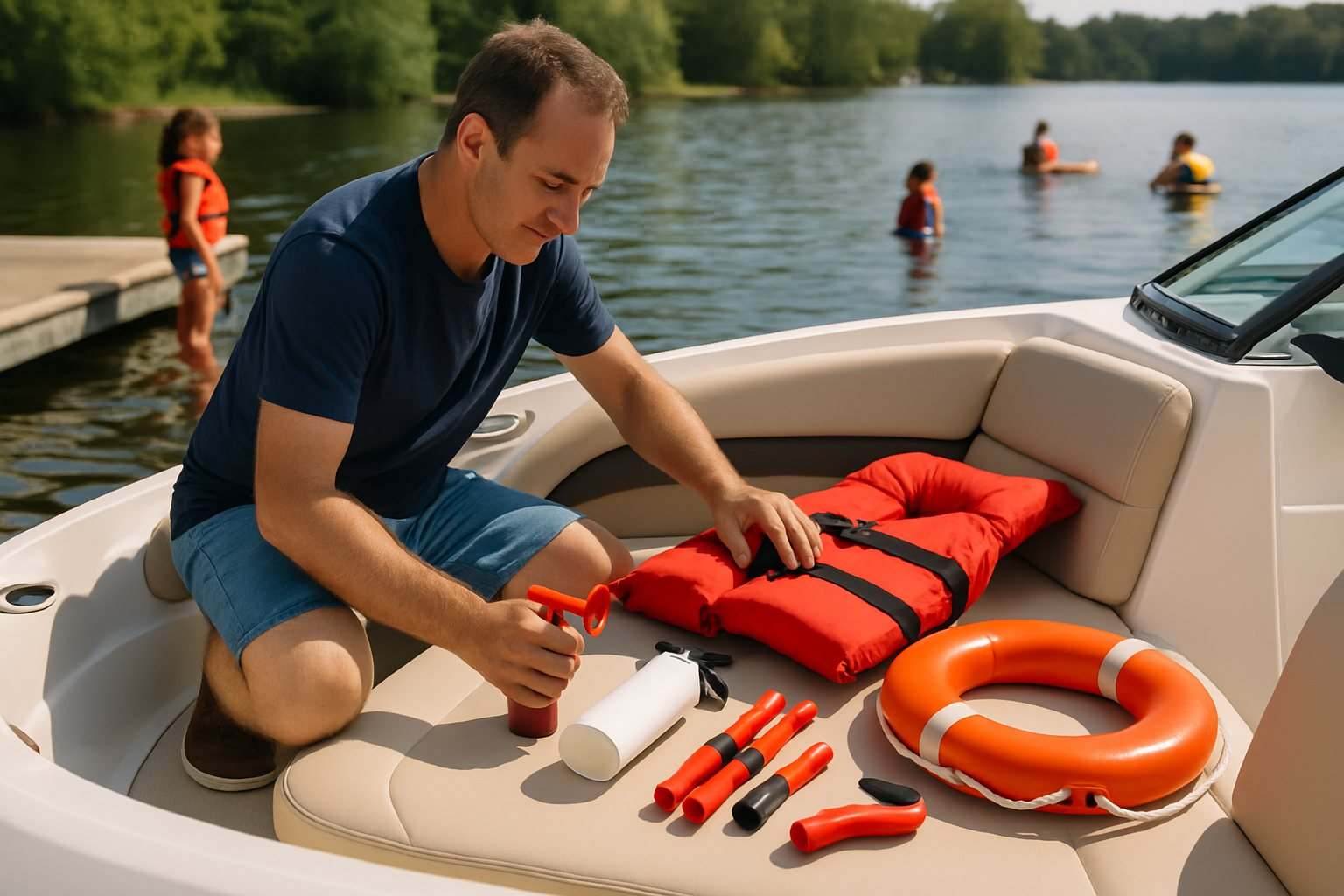
It’s the first warm Saturday of the season. The pontoon is back in the water, the slide is strapped to the rail and the cooler is full, and then a patrol boat idles over for a courtesy check. “Life jackets for everyone? Throwable? Fire extinguisher?” It’s the moment every owner wants to answer with a calm yes. These are the Coast Guard boat requirements: the federal minimum equipment for a recreational boat, set by its length and how it’s powered, plus the registration, hull number and capacity rules that come with it.
In short: every recreational boat needs a Coast Guard approved wearable life jacket for each person, and boats 16 ft and over also need a throwable device. Motorboats add fire extinguishers (by length), a way to make a sound signal, navigation lights from sunset to sunrise and, on gasoline inboards, ventilation and backfire flame control. Boats on coastal waters and the Great Lakes need visual distress signals. States can add more, so check your state’s boating agency too.
USCG required equipment: the checklist table
A summary of the federal rules (33 CFR and 46 CFR) and the Coast Guard’s Boater’s Guide to the Federal Requirements for Recreational Boats, not the legal text.
| Item | Which boats (federal rule) | What the rule says |
|---|---|---|
| Wearable life jackets | All recreational boats | One USCG approved wearable for each person, the right size, in serviceable condition and readily accessible. Children under 13 wear one while underway (or your state’s age rule). |
| Throwable device (Type IV) | 16 ft and over (canoes and kayaks exempt) | One, in addition to the wearables, immediately available. |
| Fire extinguishers | Motorboats, by length | Under 26 ft: one 5-B. 26 ft to under 40 ft: two. 40 ft to 65 ft: three. A fixed system in the engine space reduces the count by one; one 20-B can replace two 5-B. Outboard boats under 26 ft built so vapors can’t be trapped are exempt. |
| Visual distress signals | Boats on coastal waters, the Great Lakes and the territorial seas | 16 ft and over: day and night signals. Under 16 ft: night signals between sunset and sunrise. |
| Sound-producing device | All vessels | Under 12 m (39.4 ft): some means of making an efficient sound signal. 12 m and over: a whistle. 20 m and over: a bell as well. |
| Navigation lights | All vessels | Shown from sunset to sunrise and in restricted visibility. A powerboat under 12 m may show sidelights and an all-round white light. |
| Ventilation | Gasoline-engine boats built after July 31, 1980 | An operable ventilation system meeting the federal standard. |
| Backfire flame control | Gasoline engines installed after April 25, 1940, except outboards | An approved backfire flame arrestor or other accepted means. |
| Engine cut-off switch | Boats under 26 ft with one installed | The operator wears the link when on plane or above displacement speed (federal law since April 1, 2021). |
Life jackets and the throwable device
Under 33 CFR 175.15, every recreational boat needs at least one wearable life jacket per person, used as its approval label says, and a boat 16 ft or longer also needs one throwable. Wearables must be readily accessible, not locked away or buried under gear; the throwable must be immediately available. Each jacket must fit its wearer as marked, show its approval number, and be free of rips, broken buckles or waterlogged foam. The Coast Guard says life jackets are the item most often cited in boardings. See life jackets on boats for sizes and fit.
Fire extinguishers by boat length
Marine-type Class B extinguishers are required where the boat’s build could trap fuel vapors: closed compartments where portable tanks may be stored, double bottoms not sealed or filled with flotation, closed living spaces, closed storage for flammables, or permanently installed fuel tanks. They must be approved, readily accessible, unused and unexpired, with the gauge in the operable range and the pin in place. Boats from model year 2018 on carry 5-B or 20-B units; older boats may keep B-I or B-II units while they stay serviceable. The Coast Guard guide says non-rechargeable extinguishers expire 12 years from the date stamped on the bottom.
Visual distress signals, sound and lights
Distress signals are required on “coastal waters”: the Great Lakes, the territorial seas, and connected bays, sounds and rivers until they narrow to 2 nautical miles. Elsewhere the Coast Guard still recommends carrying them. Options include three handheld red flares (day and night), an orange distress flag at least 3 by 3 ft (day) and an electric distress light (night). Pyrotechnics expire 42 months after manufacture.
Sound signals are used when meeting, crossing or overtaking, in reduced visibility and at anchor; boats under 12 m need “some other means of making an efficient sound signal”, such as a horn or whistle. Lights go on from sunset to sunrise and in fog, rain or haze, with an all-round white light at anchor (vessels under 7 m anchored away from channels and traffic are exempt). The Coast Guard Navigation Center publishes the full rules.
Ventilation and backfire flame arrestors
These apply to gasoline inboard and sterndrive engines (see the table). Boats with remote starters carry a label saying to run the blower at least four minutes and check the bilge for vapors before starting, and arrestors must be Coast Guard approved or marked to SAE J-1928 or UL 1111.
Capacity plates, registration and hull ID
- Capacity plate: the federal marking rule covers monohull boats under 20 ft (not sailboats, canoes, kayaks or inflatables). It shows maximum persons, maximum weight and maximum horsepower. The federal definition says a pontoon boat is not a monohull, so follow your pontoon’s own label and manual. Never load past the plate.
- Registration: any vessel with an engine is numbered by its state of principal use, with the certificate on board (paper or digital) and numbers at least 3 inches high on both sides of the bow half. Some states also register boats without engines.
- Hull identification number (HIN): builders permanently fix a primary and a secondary HIN; home builders get one through their state.
- Accident reports: federal rules require a report for a death, a disappearance, an injury needing more than first aid, damage of $2,000 or more, or the loss of the boat. States may be stricter.
States can add rules
Federal requirements are the minimum. Florida, for example, adopts the Coast Guard equipment rules and adds its own: children under 6 must wear a life jacket on boats under 26 ft while underway. Other states set their own education, registration and life jacket rules. Find yours in the NASBLA state boating agency directory, and see boater education and state rules. If you’d like someone to look over your boat, the Coast Guard Auxiliary and America’s Boating Club offer free Vessel Safety Checks.
Gear that helps you meet the list. Prices change; these are what we saw on Amazon in October 2026. Check the Coast Guard approval and rating on the label before you buy.
Stearns Throwable Flotation Cushion
- USCG approved Type IV
- 16 x 14 in, webbed straps
- About $21
Stearns Adult Classic Life Vest
- USCG approved Type III
- Adults 90 lb and over
- About $34
Coast Guard requirement questions
Does a pontoon boat need a throwable life ring?
Under the federal rule, any recreational boat 16 ft or longer (except canoes and kayaks) must carry one throwable device in addition to a wearable life jacket for each person. Measure your pontoon’s length: if it’s 16 ft or more, carry one. A Type IV cushion or ring counts.
Do I need flares on a lake?
The federal requirement covers coastal waters and the Great Lakes, plus waters connected to them until they narrow below 2 nautical miles. On other inland lakes it doesn’t apply federally, though the Coast Guard recommends carrying signals anywhere. Check your state’s rules.
Do I have to carry my registration on board?
Yes. Federal rules require the certificate of number on board, in hard copy or digital form, whenever the boat is used (short rentals of boats under 26 ft have an exception).
How many fire extinguishers does a 24 ft pontoon need?
If the construction requires one (for example a permanently installed fuel tank or closed compartments where fuel may be stored), boats under 26 ft need one 5-B extinguisher, or none if a fixed system protects the engine space. Outboard boats under 26 ft built so they can’t trap vapors are exempt.
The Coast Guard doesn’t regulate diver or ski flags; states do (see swimming from a boat). Back to the boat safety hub, or read about carbon monoxide on boats before your next swim stop.