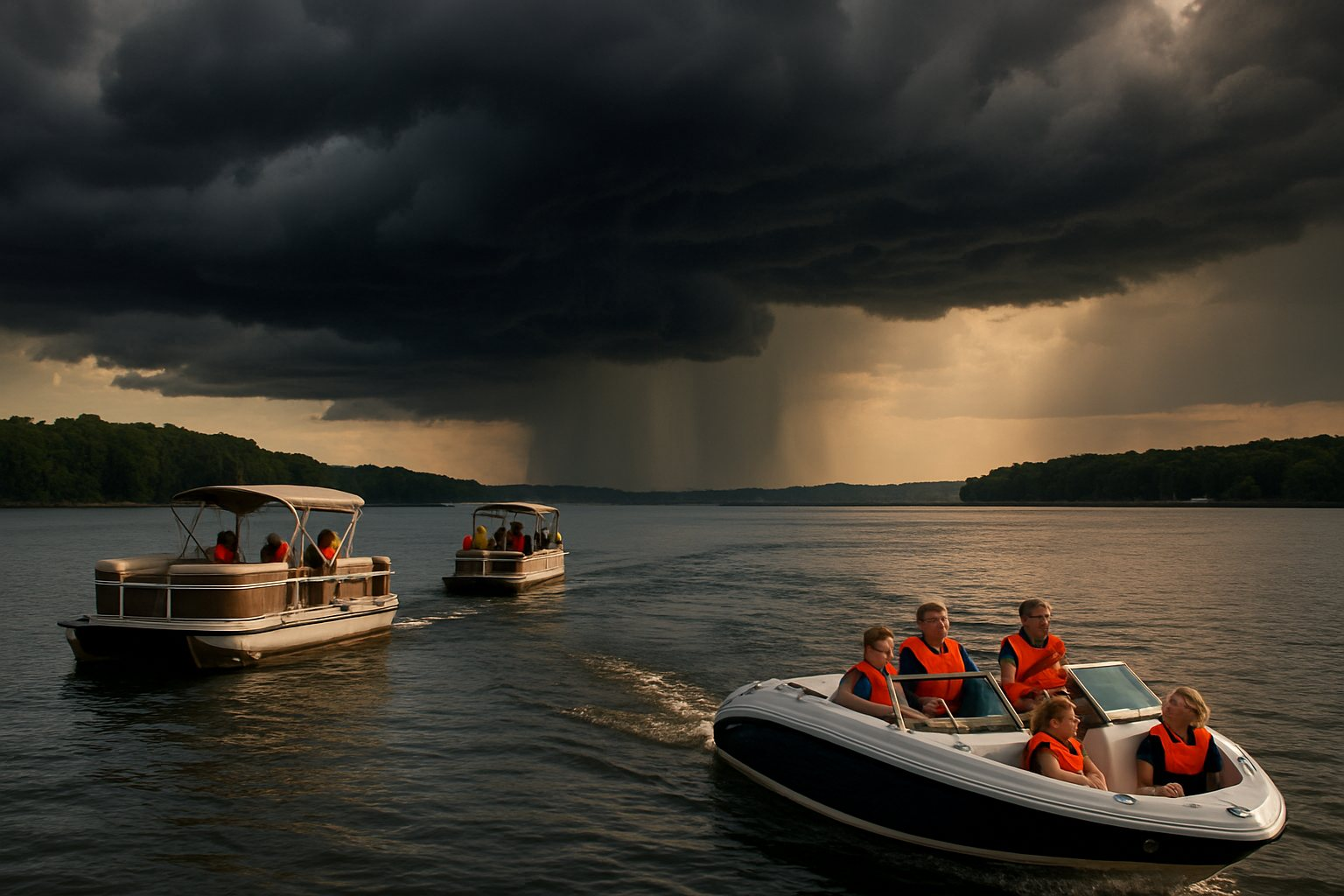
It’s two in the afternoon, the kids are on their twentieth slide run, and the sky to the west has gone from white to a bruised gray. Somebody says “it’s miles away.” Then comes the first low rumble. Summer boat days turn on moments like this, and boating weather safety is about deciding before that moment: checking the forecast, watching the sky, and knowing when to pack up the slide and head in.
In short: check the National Weather Service marine forecast before you go and keep listening on the water (NOAA Weather Radio broadcasts around the clock). If thunderstorms are forecast, plan another day. If you hear thunder, head to shore and shelter, and wait at least 30 minutes after the last thunder. No slide maker publishes a wind limit, but RAVE’s manual says never to use its slide in rough water, storms or lightning. Dress for the water temperature, not the air, and respect rip and tidal currents.
Boating weather safety starts with the forecast
The Coast Guard lists checking the weather before you leave, and watching for changing conditions, among every operator’s responsibilities. The National Weather Service (NWS), part of NOAA, publishes marine forecasts for coastal waters and the Great Lakes, and local forecasts for inland lakes. Useful products and terms:
| NWS product | What it means |
|---|---|
| Coastal Waters Forecast / Nearshore Marine Forecast | Wind, waves and weather for coastal and Great Lakes zones. |
| Small Craft Advisory | Issued by coastal and Great Lakes forecast offices. Thresholds are specific to each area, and the NWS says there’s no precise definition of a small craft: any boat that could be affected should treat it as meant for them. |
| Special Marine Warning | Short-lived hazards, usually up to 2 hours: thunderstorm winds or gusts of 34 knots or more, hail 3/4 inch or larger, or waterspouts. |
| NOAA Weather Radio All Hazards | Continuous broadcasts of NWS warnings, watches and forecasts, 24 hours a day. |
Weather matters in the numbers too. In the Coast Guard’s Recreational Boating Statistics 2024, weather was the primary contributing factor in 188 incidents with 55 deaths in 2024, and hazardous waters in 172 incidents with 53 deaths.
Lightning: when thunder roars, head in
The NWS says there is no safe place outside when thunderstorms are in the area, and that if you hear thunder you’re likely within striking distance. Its advice is to get out of and away from bodies of water. The CDC’s lightning guidance for boaters is specific:
- Check the forecast before any boating trip; if it calls for thunderstorms, plan the trip for another day.
- Keep listening to weather information while you’re out.
- If you’re on a boat in open water when a thunderstorm rolls in, return to shore immediately and seek shelter. Once on land, get at least 100 yards away from shore.
- Lightning can strike more than 10 miles from a storm.
- Don’t resume outdoor activities for at least 30 minutes after the storm. The NWS says the same: stay sheltered at least 30 minutes after the last thunder.
For slide days that means: at the first rumble, everyone out of the water, slide off, and head in. A slide in the water at anchor is not a reason to wait it out.
Wind and waves
No boat slide maker we checked publishes a wind limit, and we won’t invent one. What makers do say: RAVE’s Pontoon Slide manual says not to use the slide in rough water, storms or lightning, or after sunset or before dawn. So the call is yours: if the water at the landing zone is getting rough, bring the slide in and the swimmers aboard. Swamping and the force of waves and wakes both appear among the Coast Guard’s incident causes, so don’t wait for the forecast to catch up with the sky. Our water depth and clearance page covers the landing zone.
Cold-water shock
Warm air doesn’t mean warm water, the NWS warns. Its cold-water facts:
- Cold shock can be as severe at 50 to 60°F (10 to 15°C) as at 35°F (2°C).
- Gasping and rapid breathing can be triggered by water as warm as 77°F (25°C).
- The gasp and rapid breathing come in the first 2 to 3 minutes or more, followed by a loss of muscle control in arms and legs; hypothermia begins when core temperature drops to 95°F (35°C).
- Wearing a life jacket significantly increases the chance of survival.
The Coast Guard’s guide describes the same phases: cold shock that passes in about a minute, cold incapacitation within about 10 minutes, then hypothermia. Its advice in the water is to get as much of your body out as possible, and if you can’t, to hold the H.E.L.P. position (knees to chest, arms across the life jacket) or huddle with others. The NWS says dress for the water temperature and check it before you go.
Rip currents and tidal currents
NOAA describes rip currents as powerful, narrow channels of fast-moving water, found along the East, Gulf and West coasts and the Great Lakes, moving at up to eight feet per second. If caught in one, NOAA says: don’t fight it, swim parallel to the shore, then swim back to land at an angle. The NWS adds that rip currents often form on calm, sunny days. NOAA also explains that a “rip tide” is different: a fast tidal flow through inlets and the mouths of estuaries, bays and harbors. If you anchor near an inlet, a harbor mouth or in a river, that swift flow can carry swimmers away from the boat, so check NOAA’s tide and current predictions and keep a throwable device ready.
Go or no-go checklist
| Check | Go | No-go or head in |
|---|---|---|
| Thunderstorms | None forecast | Forecast, or thunder heard |
| Marine alerts | None for your zone | Small Craft Advisory (if it affects your boat) or Special Marine Warning |
| Water surface | Calm at the landing zone | Rough water (RAVE: no slide use) |
| Water temperature | Dressed and prepared for it | Cold water without a plan |
| Light | Daylight | After sunset or before dawn (RAVE: no slide use) |
Weather questions
What should I do if a thunderstorm catches me on the water?
The CDC says return to shore immediately and seek shelter, then get at least 100 yards away from shore. Get swimmers aboard and the slide in first.
How long should I wait after thunder to swim again?
At least 30 minutes after the last thunder, according to the NWS and the CDC.
Is there a wind limit for boat slides?
No maker we checked publishes one. RAVE’s manual says no use in rough water, storms or lightning. Judge the landing zone and bring the slide in early.
Is a Small Craft Advisory for my boat?
The NWS says there’s no precise definition of a small craft; any vessel that may be adversely affected should consider itself one, taking into account the operator’s experience and the boat’s type, size and seaworthiness.
How cold is too cold to swim off the boat?
There’s no single number. The NWS says gasping can start in water as warm as 77°F (25°C) and that cold shock is as dangerous at 50 to 60°F as near freezing. Wear life jackets and keep swims short in cool water.
Back to the boat safety hub. Related: swimming from a boat, kids on boats and life jackets on boats.