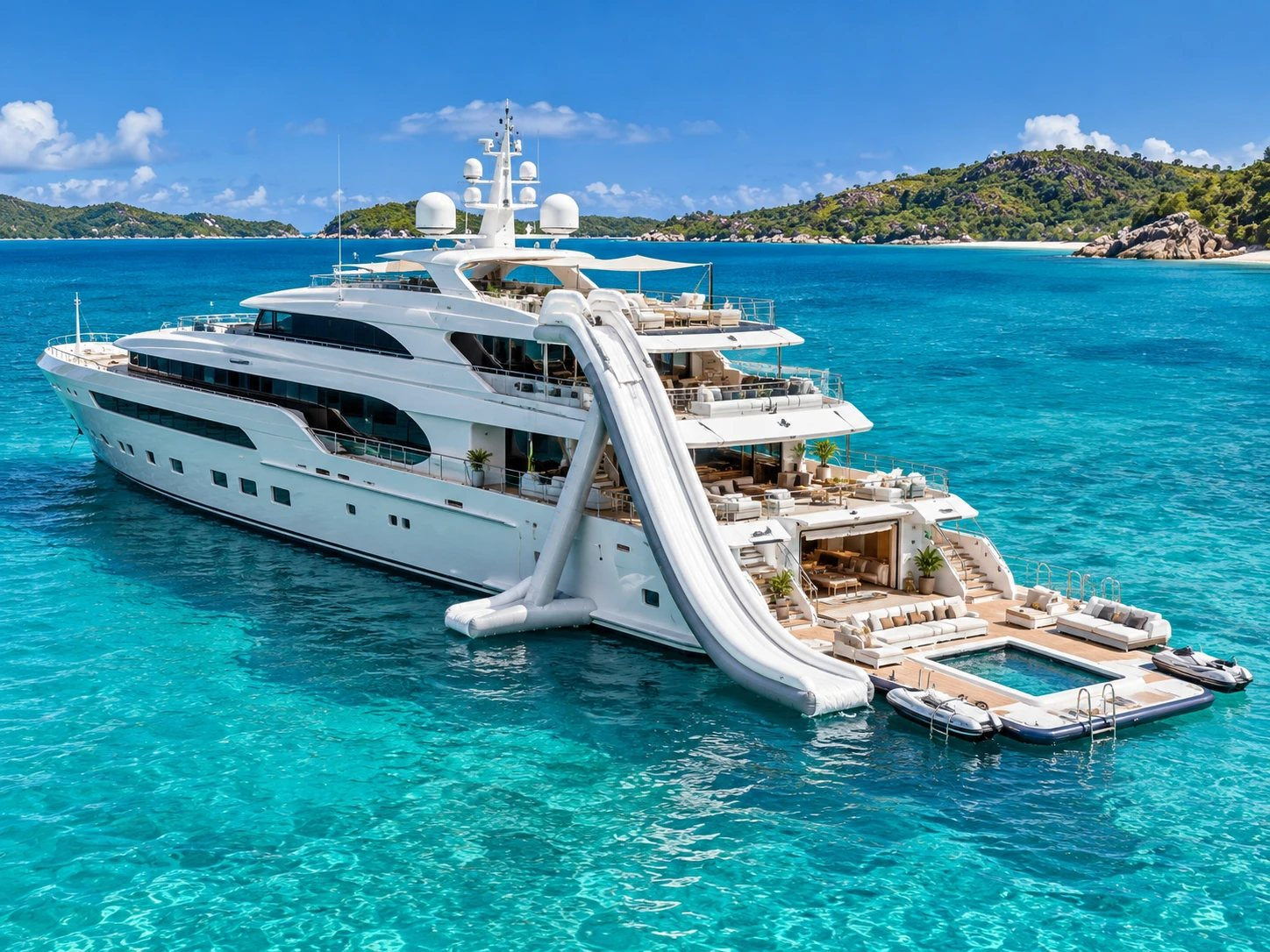
Mid-morning in a Mediterranean anchorage. The tender is out, the toys are lined up on the swim platform, and two deckhands are walking a long, rolled-up slide to the rail of the upper deck. Twenty minutes later it’s hanging in a clean arc down the hull, water running along its length, and a guest who swore she was “just here for the sun” is first down. A superyacht slide is the most visible toy on board, and almost every one is built for its yacht. This guide explains how a custom yacht slide is designed and ordered, the designs makers offer, who builds them, and what to prepare before you ask for a quote.
In short: superyacht slides are inflatable slides sized to the drop from the yacht’s rail to the waterline, from about 4 m up to custom builds over 12 m. Makers such as FunAir, FreeStyle Slides and Superyacht Tenders & Toys design them from the yacht’s General Arrangement (GA) drawings or a measuring guide, build a 3D fit model, then make the slide to order. Prices are by quote.
What makes a superyacht slide different
On a pontoon, a slide is an accessory you strap on. On a superyacht, it’s closer to a piece of equipment fitted to the boat. The drops are bigger (FunAir’s Hanger Extreme covers 7 to 9.5 m, and its Riser 9.5 m and up), the slide has to clear the rails (FunAir’s sit 10 to 15 cm above them), it has to tie to planned anchor points, and crew need a safe way to lift, deploy and recover it. Charter broker Fraser notes that yacht slides can exceed 13 m. That’s why makers treat each one as a project.
How a custom yacht slide is made
- Measurements. FunAir’s preferred method is a scaled GA drawing, from which its team can “typically extract all the necessary measurements”. Without one, it sends the captain a step-by-step measuring guide using photos and key measurements. Our rail-to-waterline guide explains the main number.
- Choosing the position and design. Over the side from a high deck, from the bow, off the stern, curved back toward the swim platform, or a flume. The maker works with the captain on where it fits and how it will be rigged.
- 3D fit model. FunAir says its in-house engineering team creates 3D CAD models for every custom order, to check the fit on that specific yacht.
- Branding and colour. FunAir and FreeStyle both offer custom colours and the yacht’s name or a charter brand logo.
- Lifting and storage plan. FunAir supplies lifting straps and offers a lifting plan for each yacht; Superyacht Tenders & Toys fits lifting bridles for crane or davit.
- Build and delivery. Lead times for fully custom slides vary with the design, by FunAir’s account. Stock QuickShip slides ship within days.
Superyacht slide designs
| Design | What it is | Stated size (FunAir) |
|---|---|---|
| Hanger Extreme | Over the rail from a top or sun deck | 7–9.5 m drop, yachts 50 m+ |
| Riser | Stands on its own; top-deck entry | 9.5 m+, yachts 60 m+; about 60 min setup |
| Self-Lifting | Lifts itself during deployment | 10 m+, yachts 60 m+ |
| Bow | Fitted to the bow; frees the aft deck | 3–12 m, all sizes |
| Stern | From the stern when over-the-rail isn’t possible | 3–12 m, all sizes |
| Curved | Lands riders closer to the swim platform | 3–12 m, yachts 50 m+ |
| Flume | Fully custom, rider “flying through the air” | Any size |
| Freestanding (Apex Extreme) | Anchored off the stern or in a bay | 5 m tall |
Entry styles vary too. FunAir offers traditional, vertical and deck-entry slides; Superyacht Tenders & Toys builds flat-entry or 45-degree angled-entry slides. And slides can be more than one: in 2013, Superyacht Tenders & Toys and FreeStyle built two identical 41 ft S-shaped, self-lifting slides running from either side of the helideck of a 70 m yacht. For the design that raises itself, see self-lifting yacht slides; for a slide that floats, floating water slides.
Who builds custom yacht slides
- FunAir (Austin, Texas): the widest documented range, from QuickShip models to every custom design above. Materials: 0.6 or 0.9 mm 1,000-denier PVC with FR and UV ratings, 316 stainless hardware, hot-air welded seams, a no-jump net and vinyl arms “to prevent slide burns”; 5-year limited warranty.
- FreeStyle Slides (St Petersburg, Florida): makes the FreeStyle Cruiser, which it calls “the world’s first sealed-air inflatable yacht slide”, fully customizable in colour and logo.
- Superyacht Tenders & Toys (UK and Monaco): made-to-order slides in Marine-X high-tensile PVC, which it says is about 30 kg lighter on average, with multiple valves for up to three pumps at once.
- Yachtbeach: drop-stitch Magic Yachtslides up to the 7.2, for railings up to 620 cm, sold through dealers.
FunAir Riser
by FunAir
- Deck / rail height it fits: Over 9.5 m rail-to-waterline
FunAir Self-Lifting slide
by FunAir
- Deck / rail height it fits: Over 10 m rail-to-waterline
Superyacht Tenders & Toys yacht slide
by Superyacht Tenders & Toys
Request more informationWe list makers for information; we’re an independent guide and don’t sell slides. See all maker profiles on Makers.
Features that matter on a superyacht slide
- Water on the slide. FunAir builds in a removable water distribution system connected to a standard hose bib, with laser-drilled holes of different sizes along the slide, which it says spreads water evenly and keeps excess water off the deck.
- Rider protection. FunAir fits smooth vinyl arms to prevent slide burns and a no-jump net at the top.
- Fast inflation. FunAir’s RapidFlate system, used on the Riser, reduces inflation and take-down time by six times compared with traditional methods, by FunAir’s account. SYTT slides take up to three pumps at once.
- Handling points. Lifting handles, reinforced crane straps or bridles, and ring points for tying off.
- A way back up. Plan how swimmers get back aboard: a swim platform, boarding ladder or, for freestanding slides, steps from the water such as FunAir’s SeaStairs.
Superyacht slides on charter
Slides are a charter favourite, and brokers file yachts by them: Fraser and Northrop & Johnson both have waterslide categories. Documented examples include Utopia (62 m) with a 10 m slide and Slipstream (60 m), which took delivery of a custom slide in 2016. FunAir aims its Self-Lifting slide at “busy charter yachts”, where crew deploy and recover the slide often. Fraser describes how slides are used on charter: deployed when the yacht anchors in calm, protected waters, with crew supervising.
Before you ask for a custom yacht slide quote
- The yacht’s length and the GA drawing, or the rail-to-waterline height at each candidate deck.
- Where you’d like the slide (side, bow, stern, top deck) and where it will be stored.
- Crane or davit capacity and reach, for lifting.
- How often it will be used: family summers or a full charter season.
- Colours, logo and when you need it.
Send those through Request more information and we’ll pass your request to makers who build superyacht slides. For budget context, read how much a yacht slide costs; for every slide type, our marine slides guide; and for stock models, the best yacht slides. All pieces on big-boat slides are in luxury yacht slides.
Superyacht slide questions
How big can a superyacht slide be?
FunAir builds custom designs exceeding 12 m, and Fraser notes slides over 13 m on charter yachts. A documented 2013 build was 41 ft, S-shaped, from a 70 m yacht’s helideck.
Will a slide damage the yacht’s rails?
FunAir says its slides sit 10 to 15 cm above the rails, so there’s no direct contact or pressure on them, and that anchor points and rigging are planned during design.
What is a GA drawing and why do makers want it?
A General Arrangement drawing is the yacht’s scaled layout plan. With one, FunAir says it can usually take every measurement it needs directly from the drawing; it’s the maker’s preferred method. See our glossary.
How many crew does a superyacht slide need?
It depends on the design. FunAir gives about 20 minutes for a Hanger and around 60 minutes for a Riser, and says self-lifting arms reduce both crew and setup time on XL slides. The freestanding Apex Extreme takes four crew about 30 minutes.
Is there a wind limit for yacht slides?
No yacht slide maker we checked publishes one. Charter practice, as Fraser describes it, is to deploy in calm, protected waters with crew supervising; the captain makes the call.