
This article contains affiliate links: if you buy through them we may earn a commission, at no extra cost to you. Read our affiliate disclosure.
It’s mid-afternoon at the sandbar. The pontoon is anchored, the cooler is half empty, and three kids are lined up at the side gate waiting for their turn to shoot into the lake. Behind them, a neighbor’s double-decker has a shiny slide bolted to its top deck, and someone asks the question that starts most slide shopping: should we get an inflatable boat slide we can pack away, or a fiberglass slide that stays on for good? This guide compares the two side by side, using what the makers publish, so you can pick the one that fits your boat and your summers.
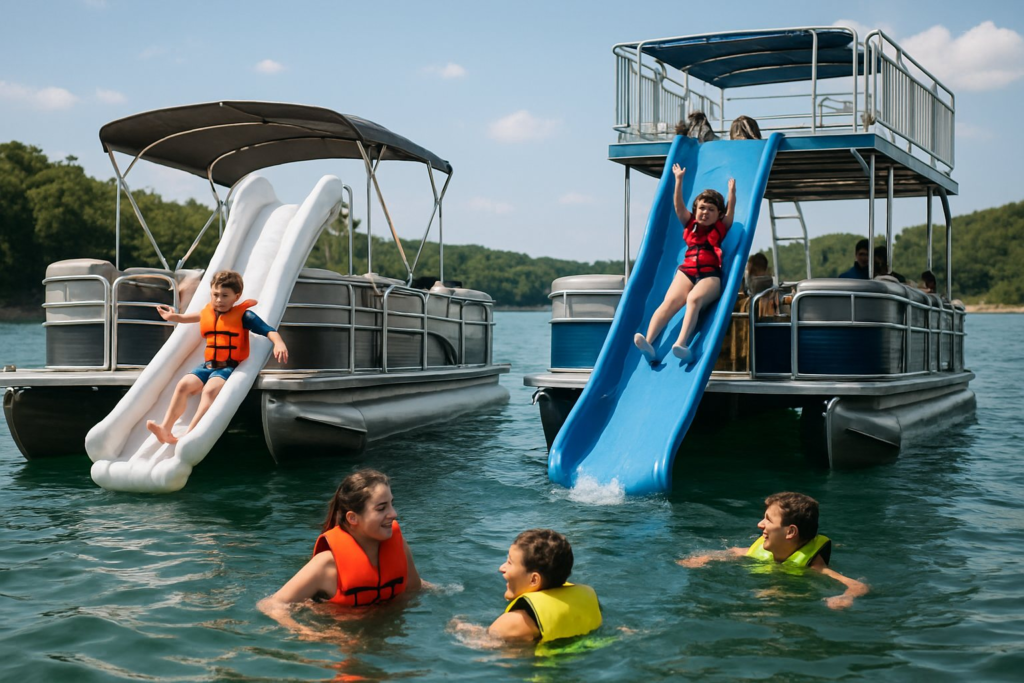
In short: an inflatable boat slide is the flexible choice: it straps on in minutes, rolls up under a seat and costs about $200 to $750 on Amazon in October 2026. A fiberglass slide is a permanent fixture that needs an upper deck or high platform and a solid mount, and it is sold as a factory option on some pontoons or made to order by small fiberglass shops. Most boaters start inflatable; fiberglass makes sense when your boat already has the height and you want the slide ready every day.
What an inflatable boat slide is
An inflatable boat slide is a PVC air chamber shaped into a ladder on one side and a slide on the other. You drape it over a side gate or the edge of the deck, pump it up and strap or tie it to the boat. Two kinds are on sale. Tube-style pontoon slides such as the RAVE Pontoon Slide, the Airhead Spillway and the O’Brien Pontoon Slide are big, round, low-pressure chambers with molded steps and handles. Drop-stitch slides such as the Lakesurf Slide Island are flat panels pumped to a higher pressure (Lakesurf says at least 5 psi and no more than 10 psi) so they stay rigid like a paddle board.
Sizes are similar across the tube-style models: RAVE states 10 ft long by 68 in high with a 9 ft sliding surface, Airhead states 10.5 x 2.75 x 4.5 ft with an 8 ft surface, and O’Brien lists 105 in long by 70 in high. Every one of these makers states a 200 lb rider limit. Slide Island is the exception at 300 lb in slide mode, and it also works as a floating mat when you lay it flat.
What a fiberglass boat slide is
A fiberglass slide is a rigid, gel-smooth chute, the kind you remember from a playground or a water park, mounted to a high deck so riders drop into the water. On boats you meet it in three places:
- Factory options on double-decker pontoons. Bennington offers a fiberglass slide from the upper deck on its Top Deck layouts, with adjustable water pressure; on the L25 Quad Bench Top Deck the slide is fed by the boat’s shared washdown pump. Bennington rates that upper deck for 4 people or 585 lb. See more boats like this in boats with slides.
- Made-to-order slides from small fiberglass shops. Goldco Fiberglass (Fiberglass Fun) lists slides for houseboats, pontoon boats and docks in lengths from 8 to 22 ft, each with a recommended deck height, and says they are hand made to order. Fiberglass Concepts in Somerset, Kentucky, sells 10 ft, 12 ft and curved 12 ft slides made for houseboats.
- Dock-mounted slides from dock makers, which are a cousin of the boat slide; our best dock slides guide covers those.
One source we read puts it plainly: fixed pontoon slides “require an upper deck and professional installation.” We found no stand-alone aftermarket rigid slide kit sold specifically for boats, so if your boat has no top deck, a fiberglass slide is a custom project, not a weekend add-on.
Inflatable vs fiberglass boat slide at a glance
| Inflatable boat slide | Fiberglass boat slide | |
|---|---|---|
| Where it mounts | Side gate or deck edge, held by straps or tie-off rope | Upper deck or high platform, fixed mount |
| Height needed | Works from a normal pontoon deck (RAVE asks for a 21 to 30 in side rail) | Goldco lists a recommended deck height for each length, from 4 ft (8 ft slide) to 11 ft (22 ft slide) |
| Setup | Inflate and strap on; RAVE and Airhead both say about 5 minutes | Installed once; always ready |
| Storage | Deflates and rolls up under a seat or into a bag | Stays on the boat |
| Rider limit | 200 lb, one rider (RAVE, Airhead, O’Brien, WOW); 300 lb for Slide Island | Not published by the fiberglass slide makers we found; Bennington publishes the deck rating (4 people / 585 lb), not a slide rating |
| Price seen | About $200 to $750 (Amazon, October 2026) | Goldco $625 to $2,305 for the slide only, plus shipping and mounting; factory option price set by the boat dealer |
| Water on the slide | Wet it by hand or bucket before every ride | Often has a water spout or feed (Bennington’s adjustable water pressure; Goldco and Fiberglass Concepts sell spouts) |
Fit comes first: deck height and rail
The biggest difference between the two is not the material, it’s what your boat needs to have. An inflatable pontoon slide is designed around an ordinary pontoon deck. RAVE’s owner’s manual lists three checks before you buy: a secure side railing 21 to 30 in high, vertical rail supports 16 to 54 in either side of where the slide sits, and at least 30 in of clear deck width (34 in is “preferred”). Slide Island asks for a flat area about 3 ft wide at or above water level for the back edge to rest on, which is why it also suits V-drive and I/O boats, houseboats and docks.
A fiberglass slide works the other way round: the slide’s length is matched to the height of the deck it starts from. Goldco’s table pairs an 8 ft slide with a 4 ft deck, 12 ft with 6 ft, 14 ft with 7 ft, 18 ft with 9 ft and 22 ft with 11 ft. If your top deck is 6 ft above the water, that is the slide length the maker points you to. Before you shop either kind, measure your boat with our guide on will a slide fit my boat, and for yachts, how to measure rail-to-waterline.
Water depth: the same rule for both
Whatever it’s made of, a slide drops a person into the water near the boat, so depth matters more than anything on the spec sheet. RAVE’s product page says its slide “must be in minimum five feet of water,” while its 2017 owner’s manual says at least 8 ft and clear of obstructions for 20 ft in all directions. When a maker’s own figures differ, use the larger one. Lakesurf also says not to use Slide Island in water less than 8 ft deep. No fiberglass slide maker we found publishes a depth, so use the same care: check the bottom before anyone slides. Our page on water depth and clearance walks through it.
Inflatable boat slides on sale now
Prices change often. The prices below are what we saw on Amazon in October 2026; check the current price before you buy.
Lakesurf Slide Island
- Drop-stitch
- 300 lb in slide mode
- About $749
Here is how they compare on the specs makers publish, side by side with the factory fiberglass option:
| Spec | RAVE Pontoon Slide | Airhead Spillway pontoon slide | O’Brien Pontoon Slide | Bennington Top Deck slide (factory option) |
|---|---|---|---|---|
| Size (as stated) | 10 ft L x 25 in W x 68 in H; 9 ft slide | 10.5 x 2.75 x 4.5 ft; 8 ft slide | 105 in L x 24 in W x 70 in H | not published |
| Stated capacity | 200 lb rider limit | 200 lb rider limit | 200 lb rider limit | Upper deck rated 4 people / 585 lb |
| Minimum water depth | 5 ft (maker) | not published | not published | not published |
| Construction | Reinforced PVC | 1,000-denier PVC; 4 molded steps; 2 handles | Commercial-grade reinforced PVC | Fiberglass slide; adjustable water flow (on the L25 Quad Bench Top Deck, fed by the shared washdown pump) |
| Weight | 30 lb | not published | not published | not published |
| Anchoring / attachment | not published | not published | Heavy-duty anchor straps | not published |
| Inflation | 12 V high-pressure inflator included | High-pressure valve; pump not included | not published | not published |
| Warranty | 1 year | not published | not published | not published |
| Price signal | $319.99 (maker, when checked) | $604.99 (maker, when checked) | not published | not published |
| See it at RAVE Sports | See it at Airhead | See it at Overton's | See it at Bennington |
Figures as each maker states them; makers measure capacity differently. Check the product page for sources and dates.
What each one costs
Inflatables are the easy number: on Amazon in October 2026 we saw the O’Brien at about $200, the RAVE at about $320 (with its 12 V pump), the Spillway at about $605 (no pump) and Slide Island at about $749 (hand pump included). A fiberglass slide is priced as the slide alone. Goldco lists $625 for 8 ft, $675 or $725 for 12 ft (its table and product page differ), $825 for 14 ft, $2,005 for 18 ft and $2,305 for 22 ft, with shipping quoted on request, and one 18 ft slide shipped with a water spout is listed at $4,105. Fiberglass Concepts’ 2021 price list shows $1,200 for 10 ft and $1,500 for the straight or curved 12 ft. Add a mount, fittings and someone to install it, and check that the deck is built for it.
Care, storage and lifespan
An inflatable lives in a locker most of its life, and that’s where it wins or loses years. RAVE asks you to clean it with mild soap and fresh water, never petroleum products, solvents or a power washer, dry it completely, roll it loosely and store it cool, dry and shaded in a container mice can’t chew. Small holes are a patch job; our boat slide repair guide covers leaks and valves. A fiberglass slide has no air to lose, but it lives in the sun all season. The fiberglass slide makers we found don’t publish care instructions, so ask the maker or your dealer what they recommend for the finish.
Which one is right for you?
- Choose inflatable if you have a single-deck pontoon or a bowrider, want to take the slide off between trips, or are on a budget. Check your rail and deck width against the maker’s list first.
- Choose fiberglass if your boat already has an upper deck or a high, strong platform, the slide will be used most weekends, and you are ready for a fixed install.
- Buying a new pontoon? A factory top-deck slide is the cleanest way to get fiberglass; see boats with slides.
- Not sure yet? Read portable vs fixed boat slides for the day-to-day side of the decision, and the best inflatable boat slides for full reviews.
All our slide guides live under boat slides; for pontoon-specific picks see best pontoon boat slides, and before the first ride, read pontoon slide weight limits and the boat slide safety tips.
Inflatable and fiberglass slide questions
Is an inflatable boat slide as fast as a fiberglass one?
Makers don’t publish speeds, so there’s no fair number to compare. What they do publish is that both need water on the surface: RAVE and Lakesurf both warn that sliding on a dry inflatable can cause skin burns, which is why fiberglass slides usually come with a water spout or feed.
Can I put a fiberglass slide on a single-deck pontoon?
Goldco’s shortest slide is matched to a 4 ft deck height, and a normal pontoon deck sits much lower than that, so a fiberglass slide needs a raised deck or platform. We found no bolt-on rigid slide kit sold for single-deck pontoons. An inflatable pontoon slide is designed for exactly that boat.
How much weight can a fiberglass boat slide hold?
The fiberglass slide makers we found don’t publish a rider limit, and Bennington publishes the upper deck rating (4 people or 585 lb), not a slide rating. Ask the maker before you buy. Inflatables list 200 lb for one rider, or 300 lb for Slide Island.
Do inflatable slides fit boats that aren’t pontoons?
Some do and some don’t. RAVE’s manual says its slide is for pontoon boats only, not runabouts, deck boats or fishing boats. Lakesurf says Slide Island works with V-drive boats, many pontoons, I/O boats and houseboats, as long as there’s a flat area about 3 ft wide for it to rest on.
Which lasts longer?
Makers don’t publish a lifespan in years for either. Warranties give a hint of what they stand behind: one year on the RAVE and Slide Island inflatables. Storage habits matter most for an inflatable: clean, dry and shaded.