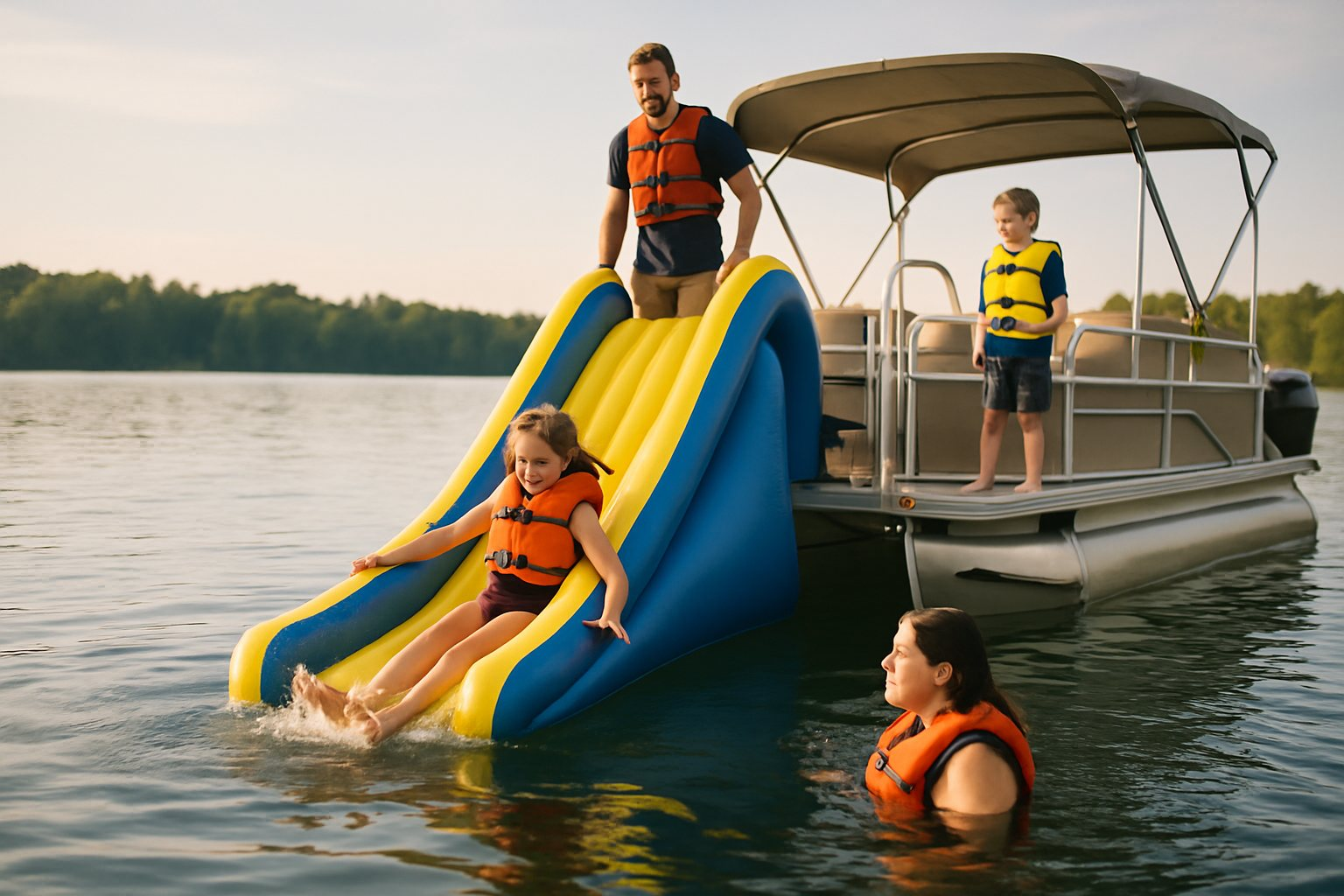
The anchor is set, the slide is clipped to the rail and three kids are already in line at the top of the steps. Before the first splash, somebody on board has to know the answers to a few grown-up questions. Is the engine off? Does everyone have a life jacket that fits? Is the water deep enough at the bottom of the slide, and is the generator exhaust blowing across the swim platform? This page brings boat safety together in one place: what the U.S. Coast Guard requires on the boat, what keeps people safe in the water, and what slide makers ask for.
In short: a boat needs the Coast Guard’s minimum equipment for its length and engine (life jackets, a throwable device on boats 16 ft and over, fire extinguishers, sound and light gear, and distress signals on coastal waters), plus whatever your state adds. People need a life jacket that fits, an engine that is off while anyone is in the water, a clear swim platform away from exhaust, a sober operator and a watchful adult. Slides add their own rules from the maker’s manual: one rider, feet first, deep and clear water.
Why boat safety starts before the slide goes on
The U.S. Coast Guard’s own figures show where things go wrong. In its Recreational Boating Statistics 2024, the Coast Guard counted 3,887 incidents, 556 deaths and 2,170 injuries in 2024. Where the cause of death was known, 76% of the people who died drowned. Alcohol was the leading known contributing factor in fatal incidents. And 169 incidents involved someone being struck by a propeller, with 30 deaths and 158 injuries. Those are the risks this section is built around: drowning, propellers, carbon monoxide, alcohol and bad weather.
A slide doesn’t change the federal equipment list, but it puts people in the water at the stern for hours, right where the propeller, the exhaust and the ladder meet. So the rules for swimmers matter as much as the rules for the boat.
Safety for the boat: what the Coast Guard requires
Federal rules set the minimum equipment by boat length and propulsion, and states can add their own. Our Coast Guard boat requirements page has the full checklist table: life jackets and the throwable device, fire extinguishers by length, visual distress signals for coastal waters, sound-producing devices, navigation lights, ventilation, backfire flame arrestors, capacity plates, registration and hull ID numbers.
Safety for the people: in the boat and in the water
- Life jackets on boats: Coast Guard approval and labels, sizes for children, the federal under-13 rule and how states differ, inflatable life jacket limits and a fit check.
- Swimming from a boat: engine off, propeller and swim-platform dangers, ladders, anchoring, diver-down and swimmer flags, and cold water.
- Carbon monoxide on boats: why the stern and swim platform are the danger zone, generators, CO alarms and the symptoms to watch for.
- Kids on boats: supervision, life jackets that fit, CDC drowning facts and the slide rules for young riders.
Safety for the day: weather, alcohol and know-how
- Weather and water conditions: NOAA and National Weather Service marine forecasts, lightning, wind and waves, cold-water shock, rip and tidal currents.
- Boating under the influence: the federal 0.08 standard for recreational operators, what the Coast Guard says alcohol does on the water, and why state law matters.
- Boater education and state rules: NASBLA-approved courses, state boating cards, and the Coast Guard license needed to carry paying passengers.
Boat slide safety: the rules from the makers
Slide makers publish their own rules in their manuals, and they’re consistent. RAVE’s Pontoon Slide manual, for example, asks for adult supervision, a U.S. Coast Guard approved Type III life jacket on every rider, one person on the slide at a time, feet first and seated, the motor stopped, and clear, deep water with no rocks, logs or sandbars. It also says no use after sunset or before dawn, or in rough water, storms or lightning. No slide maker we checked publishes an age limit or a wind limit, so those are judgment calls for the adult in charge.
For the details, read our boat slide safety tips, check the depth and open space your slide needs on water depth and clearance, and see kids and boat slides for the rules young riders should learn first.
A quick pre-swim checklist
- Required equipment on board and in good condition (see the checklist).
- A life jacket that fits each person, and children under 13 wearing theirs while underway (or your state’s rule, if different).
- Anchored from the bow, engines and generator off before anyone goes in.
- Nobody on the swim platform or in the water at the stern while an engine or generator runs.
- Water depth and open space checked against the slide maker’s manual.
- A sober operator and one adult whose only job is watching the water.
- Forecast checked, and a plan to head in at the first thunder.
Unsure whether your boat meets the rules? The Coast Guard points boaters to a free Vessel Safety Check by the Coast Guard Auxiliary or America’s Boating Club. It isn’t a law-enforcement inspection, and the examiner can explain federal and state requirements for your boat.
Boat safety questions
What safety equipment is required on a boat?
Under federal rules it depends on length, propulsion and where you boat. Every recreational boat needs a Coast Guard approved wearable life jacket for each person. Boats 16 ft and over also need a throwable device, and motorboats need fire extinguishers, lights and a sound signal. See the full Coast Guard requirements, and check your state’s boating agency for extra rules.
Does a boat slide need any Coast Guard approval?
The federal equipment rules for recreational boats don’t list water slides. Follow the slide maker’s manual for weight limits, attachment, water depth and rider rules.
Do adults have to wear a life jacket on a boat?
Federal law requires one on board for each person and wear for children under 13 while underway. The Coast Guard recommends everyone wear one, and slide makers require a Type III for every rider. Check your state’s rules too.
Where do I find my state’s boating rules?
NASBLA, the National Association of State Boating Law Administrators, keeps a directory of state boating agencies. Your state agency is the source for registration, education, life jacket and alcohol rules where you boat.
Is this legal advice?
No. We summarize federal rules and official safety guidance with links to the sources. Rules change and differ by state, so check the official text and your state’s boating agency.