This article contains affiliate links: if you buy through them we may earn a commission, at no extra cost to you. Read our affiliate disclosure.
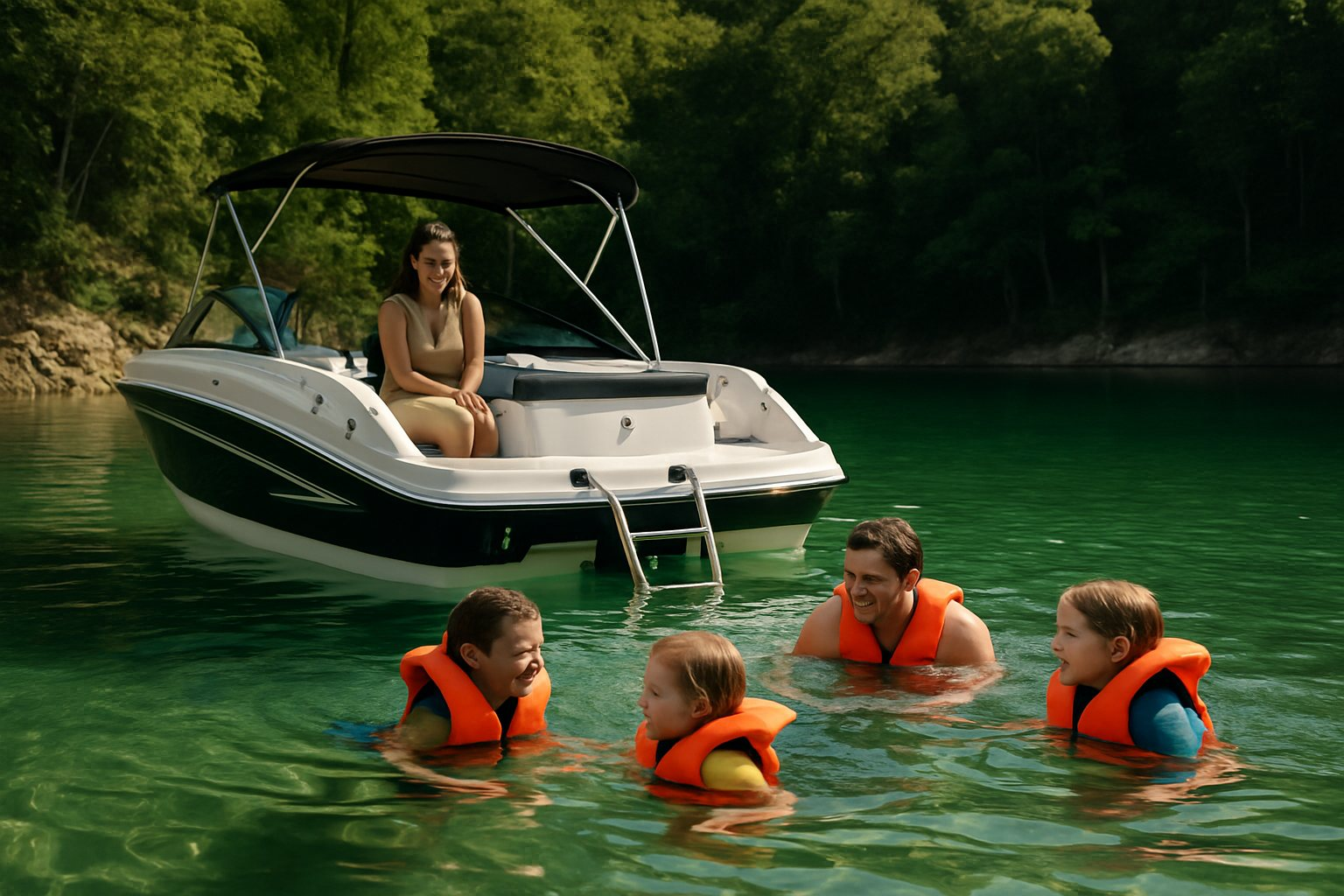
The cove is glassy, the anchor has bitten, and someone is already standing on the swim platform counting “one, two…” before cannonballing in. Swim stops are the best part of a boat day, and the slide makes them better. They’re also the moment when people in the water and a boat’s engine, propeller and exhaust are closest together. Swimming off a boat safely comes down to a short routine the captain runs every time, before anyone goes in.
In short: anchor first, then shut off the engines and the generator before anyone enters the water, and keep swimmers away from the stern, the swim platform and the exhaust. Use the ladder to get back aboard, keep a life jacket on anyone who isn’t in a designated swim area, and have one adult watching the water. Fly a flag if your state’s rules call for one, and treat cold water with respect even on a hot day.
Swimming off a boat: the safety routine
- Anchor from the bow. The Coast Guard warns never to anchor from the stern, which can swamp the boat. Its rule of thumb is five to seven times as much line as the water depth plus the height of the bow above the water.
- Engines and generator off. The Coast Guard says the best and safest action when people are in the water near your boat is to shut off your engines.
- Take the key out of the ignition or pull the cut-off lanyard, so nobody can start the engine by accident while swimmers are near the stern. A retailer’s slide guide we read puts it simply: engine off and keys out before anyone slides.
- Ladder down, swim platform clear. Swimmers climb back aboard by the ladder; slide makers such as RAVE say not to climb up the slide to get out.
- Name a Water Watcher. The Coast Guard recommends a responsible adult who watches children and adults alike, and nothing else.
- Check depth and open space before the slide or any jumping. Use the figure in your slide’s manual; see water depth and clearance.
Propellers: why the engine goes off
In 2024 the Coast Guard recorded 169 incidents in which at least one person was struck by a propeller, causing 30 deaths and 158 injuries. Its federal requirements guide says most propeller injuries and deaths involve open motorboats from 16 to 25 ft, and come from operator inattention, inexperience and carelessness. It also advises shutting off engines when approaching swimmers, and keeping people in the water on the operator’s side of the boat, always in view. Propeller guards help on some boats but, the Coast Guard says, aren’t suitable for all types.
Picking people up is the risky moment. Approach slowly, keep them in sight on your side, and shut down before they reach the stern.
The swim platform and exhaust danger zone
The swim platform is where everyone gathers, and it’s right next to the exhaust. The Coast Guard says never to sit, teak surf or hang on the back deck or swim platform while engines are running, and never to enter the area under a swim platform where exhaust outlets are unless it has been properly ventilated. Its guide adds: keep people clear of the rear deck and swim platform while the generator or engines run. NIOSH, the CDC’s occupational safety institute, found that the space under, above or around a houseboat’s swim platform may hold lethal levels of carbon monoxide when generator exhaust discharges there. Read carbon monoxide on boats before running a generator at a swim stop.
Life jackets and swim areas
The Coast Guard recommends wearing a life jacket any time you enter the water unless you’re swimming in a designated swimming area. Slide makers require a USCG approved Type III life jacket for every rider. A swim stop off a boat in open water usually isn’t a designated swim area, and currents, boat wakes and tired arms catch strong swimmers too. See life jackets on boats for sizes and fit, and keep the throwable device where you can reach it.
Diver-down and swimmer flags: state rules
The Coast Guard’s guide says it doesn’t regulate diver or ski flags, so the rules come from the Navigation Rules and from states:
- Navigation Rules (federal): a vessel engaged in diving operations that is too small to show the full lights and shapes displays a rigid replica of the International Code flag “A” (blue and white), at least 1 m (3.3 ft) high, visible all round.
- Florida (s. 327.331): divers, defined as people with a mask and snorkel or breathing gear, must show a red divers-down flag with a white diagonal stripe, at least 20 by 24 inches when flown from a boat. Boaters must try to stay at least 300 ft away in open water and 100 ft away on rivers, inlets and channels, and go no faster than needed to keep steerage inside those distances. The flag comes down once divers are out of the water.
Notice that Florida’s rule is written for divers and snorkelers, not for every swimmer. Rules for swimmer, skier-down or slide flags differ from state to state, so check your state’s boating agency in the NASBLA directory. Whatever the law, a flag never replaces a lookout.
Cold water, even in summer
The National Weather Service warns that warm air doesn’t mean warm water. Cold shock can be just as dangerous at 50 to 60°F (10 to 15°C) as at 35°F (2°C), and gasping can be triggered by water as warm as 77°F (25°C). The gasp reflex lasts the first minutes in the water, and loss of muscle control can follow. Dress for the water temperature, check it before swimming, and keep life jackets on in cold water. More in weather and water conditions.
Swim-stop gear. Prices change; these are what we saw on Amazon in October 2026. Check your state’s flag rules before you buy.
Seachoice Diver Down Flag
- 20 x 24 in, red and white
- Removable stiffener
- About $18
Stearns Throwable Flotation Cushion
- USCG approved Type IV
- 16 x 14 in, webbed straps
- About $21
Swimming off a boat questions
Is it safe to swim off a boat with the engine idling?
No. The Coast Guard says the best and safest action when people are in the water near your boat is to shut off the engines, and to keep everyone off the swim platform while engines run because of carbon monoxide.
Can I run the generator while people swim?
The Coast Guard says to keep people clear of the rear deck and swim platform while the generator runs, and NIOSH found lethal CO levels can build around a swim platform where generator exhaust discharges. Turn it off during swim time.
Do I need a diver-down flag to swim off my boat?
It depends on your state and on whether anyone is snorkeling or diving. Florida’s law, for example, applies to divers and snorkelers. Check your state’s boating agency.
Should strong swimmers wear a life jacket at a swim stop?
The Coast Guard recommends it any time you enter the water outside a designated swim area, and slide makers require one for every rider.
How deep should the water be for a boat slide?
Use your slide maker’s figure. They vary, so see water depth and clearance.
Back to the boat safety hub, or read kids on boats before the next family swim stop.