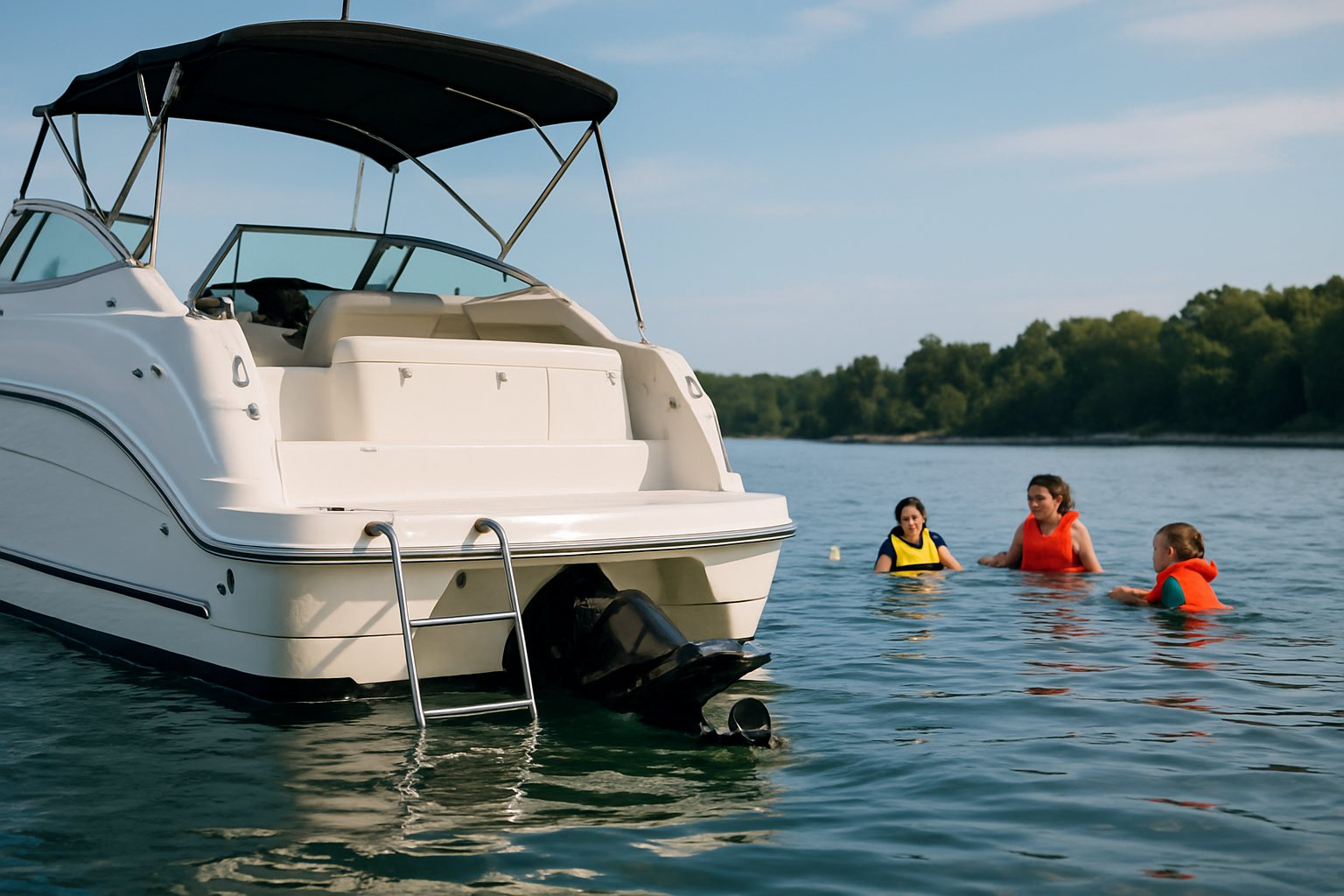
Late afternoon at the sandbar: a dozen boats rafted up, music playing, a generator humming so the blender works. Two teenagers are hanging off the swim platform, chatting, half in the water. One says he has a headache and feels sick, and everyone blames the sun. That’s how carbon monoxide on a boat fools people. You can’t see it or, often, smell it, and its first signs look like seasickness. Here’s what the U.S. Coast Guard, the CDC and NIOSH say about where it collects and how to keep it away from people.
In short: carbon monoxide (CO) comes from running engines and generators and collects around the stern, the back deck and the swim platform. The Coast Guard says never to sit, teak surf or hang on the back deck or swim platform while engines run, to keep people clear of that area while the generator runs, and to install and maintain CO alarms inside the boat. Treat headache, dizziness, nausea or weakness as possible CO poisoning: move the person to fresh air and get medical help.
What carbon monoxide does on a boat
The Coast Guard calls CO “a silent killer” on houseboats and other recreational boats, and says virtually all such poisonings are preventable. Its guide warns that CO can be present without the smell of exhaust, and that if you do smell exhaust fumes, CO is there too. In the Coast Guard’s Recreational Boating Statistics 2024, carbon monoxide poisoning was among the top five known causes of death in 2024, with 2 deaths. Low numbers on a national table don’t make the stern any safer on the day, because the danger is concentrated exactly where swimmers and slide riders gather.
The stern and swim platform danger zone
Exhaust outlets on many boats sit low at the stern, near or under the swim platform. The Coast Guard’s advice:
- Know where your engine and generator exhaust outlets are, and keep everyone away from those areas.
- Never sit, teak surf or hang on the back deck or swim platform while the engines are running. The Coast Guard says teak surfing is never a safe activity.
- Never enter the area under a swim platform where exhaust outlets are, unless it has been properly ventilated.
- Always monitor people swimming near and around the boat.
NIOSH, the CDC’s National Institute for Occupational Safety and Health, measured this on houseboats. It reported CO concentrations above 30,000 ppm in the airspace under the extended rear deck, and warned that the open space under, above or around the swim platform may contain lethal concentrations of CO if the generator exhaust discharges there. For a slide that lands near the stern, that’s the reason the generator and engines go off before anyone slides.
Generators
A generator runs while the boat sits still, which is exactly when people are in the water. The Coast Guard says to keep people clear of the rear deck and swim platform while the generator or engines are running, and to run exhaust blowers whenever the generator is on, keeping fresh air moving through the boat. NIOSH found that retrofitting a houseboat’s side exhaust with a vertical stack that vents well above the upper deck is a viable, low-cost engineering control, so if you own a houseboat with a side-exhaust generator, ask a qualified marine technician about your options. On any boat, the simplest rule for swim time is: generator off.
CO alarms on boats
The Coast Guard says to install and maintain CO alarms inside your boat, never ignore an alarm, and replace alarms as the alarm’s maker recommends. Choose an alarm sold for marine use, follow the maker’s installation instructions for where it goes in your cabin, and test it at the start of every trip. An alarm protects people inside the cabin; it can’t warn a swimmer at the stern, so the swim-platform rules still apply.
Symptoms: don’t call it seasickness
The CDC lists the most common symptoms of CO poisoning as headache, dizziness, weakness, upset stomach, vomiting, chest pain and confusion, often described as “flu-like”. It warns that people who are sleeping, drunk or otherwise impaired can die before they have symptoms. The Coast Guard adds irritated eyes and nausea, and says not to confuse CO poisoning with seasickness or intoxication.
What to do
- Get the person into fresh air immediately.
- Shut down the engines and generator, and find the source.
- Seek medical attention unless you’re sure it isn’t CO (the Coast Guard’s advice). Call 911 or hail the Coast Guard on VHF channel 16 in an emergency.
- Get anyone in the water away from the stern.
A CO checklist for slide days
| Before swim time | During swim time |
|---|---|
| Find your exhaust outlets | Engines and generator off |
| Test the cabin CO alarm | Nobody hanging on the swim platform with anything running |
| Check exhaust and generator maintenance | No one under the swim platform |
| Exhaust blowers on whenever the generator runs | Headache or nausea = fresh air and help |
The Coast Guard says regular maintenance and proper operation are the best defenses. It also offers free Vessel Safety Checks through the Coast Guard Auxiliary and America’s Boating Club.
Carbon monoxide questions
Where does carbon monoxide collect on a boat?
Around the stern: the back deck, the swim platform and the space under it where exhaust outlets are. It can also collect inside enclosed spaces, which is why the Coast Guard recommends CO alarms inside the boat.
Is it safe to sit on the swim platform while the boat idles?
No. The Coast Guard says never to sit, teak surf or hang on the back deck or swim platform while the engines are running.
Can you smell carbon monoxide?
Don’t rely on your nose. The Coast Guard notes that CO can be present without the smell of exhaust fumes, and that if you do smell exhaust, CO is present too, so act right away.
Are open boats like pontoons safe from CO?
The Coast Guard’s swim-platform and stern advice applies to any boat with a running engine or generator. Know where your exhaust outlets are and keep swimmers and riders away from them.
How is CO poisoning different from seasickness?
The early symptoms overlap: headache, nausea, dizziness, weakness. The Coast Guard says to treat seasickness symptoms as possible CO poisoning and get the person into fresh air first.
Back to the boat safety hub. Related: swimming from a boat, kids on boats and the Coast Guard equipment checklist.