This article contains affiliate links: if you buy through them we may earn a commission, at no extra cost to you. Read our affiliate disclosure.
The first run down a new slide always gets a crowd: everyone on the boat watches, the slider grins at the top, and then they’re off with a whoosh and a splash. What nobody watches is the strap or rope holding the top of the slide to the boat, and that’s the part that decides whether the hundredth run is as solid as the first. This guide is about boat slide mounting: where a slide should attach, how each maker says to attach theirs, and the checks that keep it from shifting when a 200 lb rider pushes off.
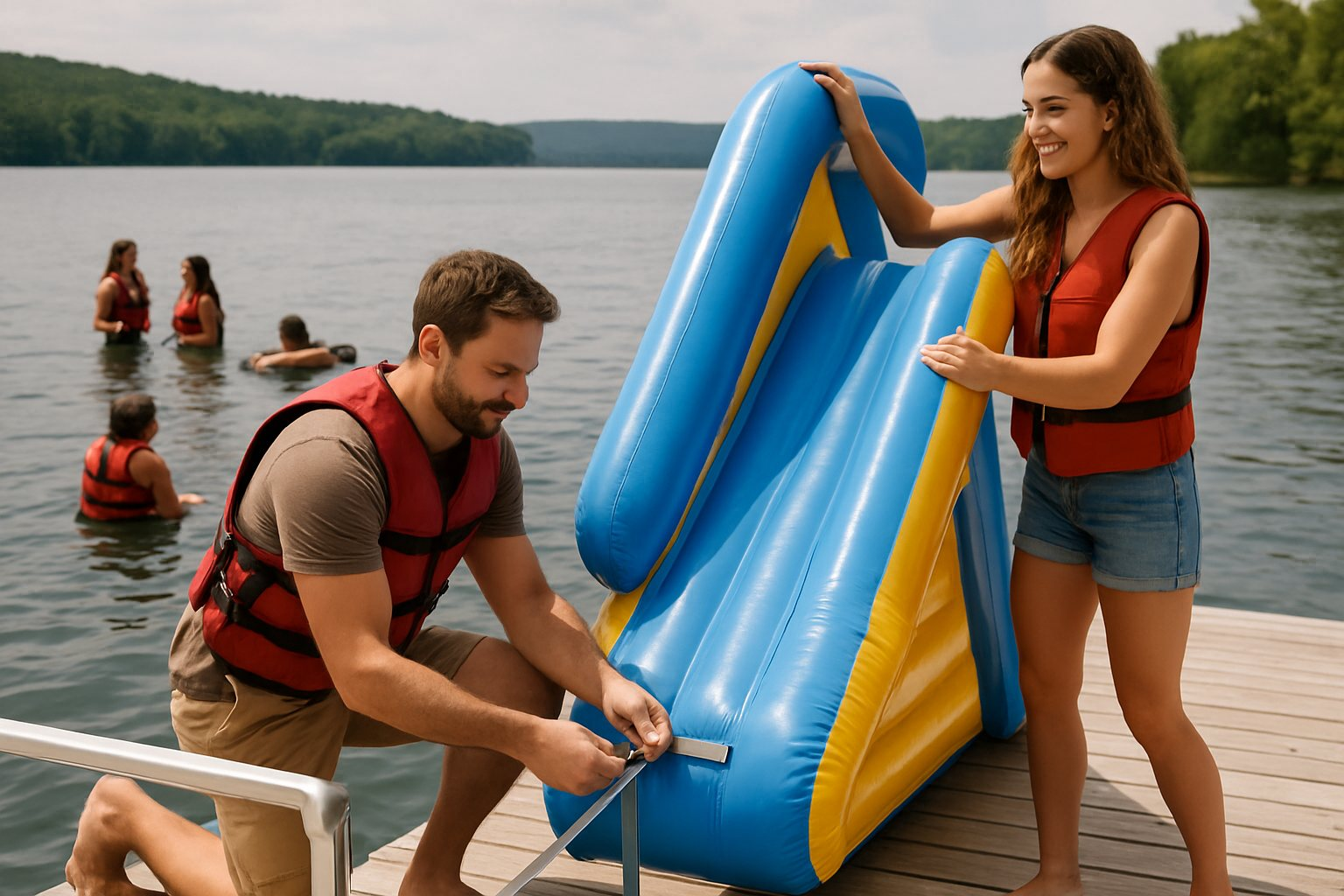
In short: attach a boat slide exactly the way its maker’s manual describes, and only to parts of the boat built to carry load: cleats, through-bolted rail bases, or anchor points the maker specifies. A railing designed to stop people leaning isn’t automatically a mounting point. On a pontoon, the RAVE slide straps to the side rail and its vertical posts, but only if the rail meets RAVE’s size and strength list; Slide Island ties to cleats; yacht slides use anchor points planned with the maker.
Structural points, not just rails
A slide carries its own weight plus a rider climbing up, sitting down and pushing off, again and again. A retailer’s guide we read put the principle in one line: “The slide should attach to structural points on the boat, not to a railing that was designed to stop people leaning.” It suggests checking whether rail bases are through-bolted with backing plates, and asking whoever services your boat if you’re not sure. That’s sound advice to carry into every install, even when the maker’s method uses the rail.
Yacht slide makers design around the same idea. FunAir says its slides sit 10 to 15 cm above the rails so there is “no direct contact, stress, or pressure on them,” and that “proper anchor points and rigging are essential,” planned during design. Yachtbeach’s Magic Yachtslide attaches to a swim platform, a yacht railing or a Yachtbeach platform, and Superyacht Tenders & Toys fits lifting bridles so a crane or davit can place the slide.
How each maker says to attach its slide
| Slide | How it attaches (maker) | What your boat needs |
|---|---|---|
| RAVE Pontoon Slide | Upper straps around the top of the side rail; lower straps around the nearest vertical rail post on each side | Secure rail 21 to 30 in high; vertical posts 16 to 54 in from the slide; 30 in clear width (34 in preferred); side gate only, never off the front |
| Lakesurf Slide Island | Three bend-locator straps and three support straps shape it; a tie-off rope runs from the loop nearest the rear cleat, through that cleat, to the forward cleat on the same side | A flat area about 3 ft wide at or above water level; two cleats on one side; sides no more than 18 in past the sun deck toward bow or stern |
| O’Brien Pontoon Slide | Heavy-duty anchor straps | Listed to fit most pontoon boats; check the instructions in the box |
| WOW Pontoon Waterfall Slide | Adjustable straps | Check the instructions in the box |
| Airhead Spillway | Method not published on the maker’s page | Listed to fit most pontoon boats |
| Paddle North Slide | Tether with a bungee, link or rope; attach from several D-rings | An anchor, boat, dock or other fixed point |
| FunAir yacht slides | Sit 10 to 15 cm above the rail; anchor points and rigging planned with the yacht | Rail-to-waterline measurement and deck layout |
| FreeStyle Cruiser XS | Mounts on the swim platform or floats on mooring ropes | A swim platform or mooring points |
Notice the pattern: each maker writes its own fit list. RAVE’s is the most detailed and also the strictest: it says that if your boat doesn’t meet those criteria, don’t use the slide at all. Measure before you buy with will a slide fit my boat.
How to attach a slide to a pontoon
Here’s the strap method from RAVE’s owner’s manual, the most common style of pontoon slide, with the structural checks added:
- Check the rail first. Push and pull on it. RAVE requires a secure, stable rail 21 to 30 in high. If it flexes, or the base fasteners are loose, fix that before any slide goes on.
- Pick the side gate. RAVE says always mount at a side gate, never off the front, with the gate closed and locked. It prefers a snug spot, such as between a seat and the helm console.
- Drape and inflate. Climbing side inside the boat, slide side over the water, then inflate until firm (see boat slide pumps and inflation).
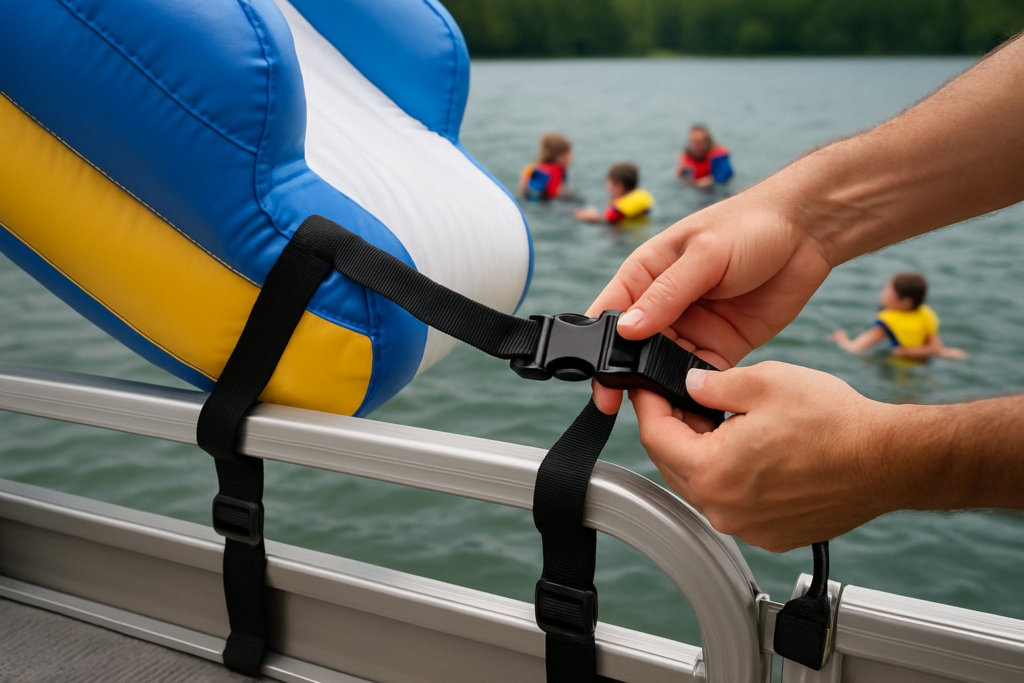
- Upper straps. Run each straight down from the slide to the top rail, wrap the rail, thread up through the center of the buckle and back down through the front. Snug both loosely, then pull both tight so the slide can’t rock side to side.
- Lower straps. Wrap each around the nearest vertical rail post (16 to 54 in from the slide) and back through its buckle; pull taut on both sides.
- Test it. RAVE says make sure the slide is firm and stable before use, adding air or adjusting straps if needed.
We have a shorter walkthrough in set up a pontoon boat slide in 5 steps; for yachts, see installing a slide on your yacht.
Tying a slide to cleats
Cleats are where a boat’s lines are made fast, and tying to them is the method Lakesurf uses for Slide Island. Set the slide on the sun deck with the slide end over the side, find the tie-off loop nearest the rear cleat, loop the rope through it, run the rope through the rear cleat, pull tight and tie it off on the forward cleat on the same side. Lakesurf adds two rules worth copying for any slide: don’t add hardware or attachments the maker didn’t supply, and don’t leave the slide attached to a boat or dock overnight, where waves can rub it against something hard.
Checks before every ride
- Boat anchored, engine off and keys out. RAVE says never have the slide inflated or attached while the motor runs or the boat moves.
- Straps or rope tight; the slide doesn’t rock when you push on the top.
- Gate closed and locked under the slide.
- Deep, clear water at the bottom: RAVE and Lakesurf both ask for at least 8 ft. See water depth and clearance.
- Slide surface wet; both makers warn a dry slide can burn skin.
- One rider at a time, under the maker’s weight limit; see pontoon slide weight limits.
Slides with a published attachment method
Prices change often. The prices below are what we saw on Amazon in October 2026; check the current price before you buy.
RAVE Sports Pontoon Slide
- Straps to rail and posts
- 200 lb, 1 rider
- About $320
Lakesurf Slide Island
- Tie-off rope included
- 300 lb in slide mode
- About $749
For yacht slides, which are sized and rigged to each boat, browse yacht slides or ask us through Request more information. All slide guides are under boat slides.
Boat slide mounting questions
Can I strap a slide to my pontoon railing?
Only if the slide’s maker designs it that way and your rail meets its requirements. RAVE’s slide straps to the rail and vertical posts, but RAVE requires a secure rail 21 to 30 in high with posts 16 to 54 in either side. If the rail flexes or its base isn’t solidly fastened, have it checked first.
Can I mount a slide off the front of a pontoon?
RAVE says never: always mount its slide at a side gate, with the gate closed and locked.
Will a yacht slide damage my handrails?
FunAir says its slides sit 10 to 15 cm above the rails, with no direct contact, stress or pressure on them, and that anchor points and rigging are planned during design. Ask your maker how theirs is rigged; measure first with rail-to-waterline.
Can I add my own clips or hardware?
Lakesurf says not to add hardware or attachments the maker didn’t supply. RAVE’s manual says to inspect for worn, defective or missing parts and replace or repair them before use, so ask the maker for replacement straps.
Can I leave the slide attached overnight?
Lakesurf says no, because wave action can rub it against a hard surface, and RAVE says never leave a slide inflated and unattended. Deflate and stow it at the end of the day.