This article contains affiliate links: if you buy through them we may earn a commission, at no extra cost to you. Read our affiliate disclosure.
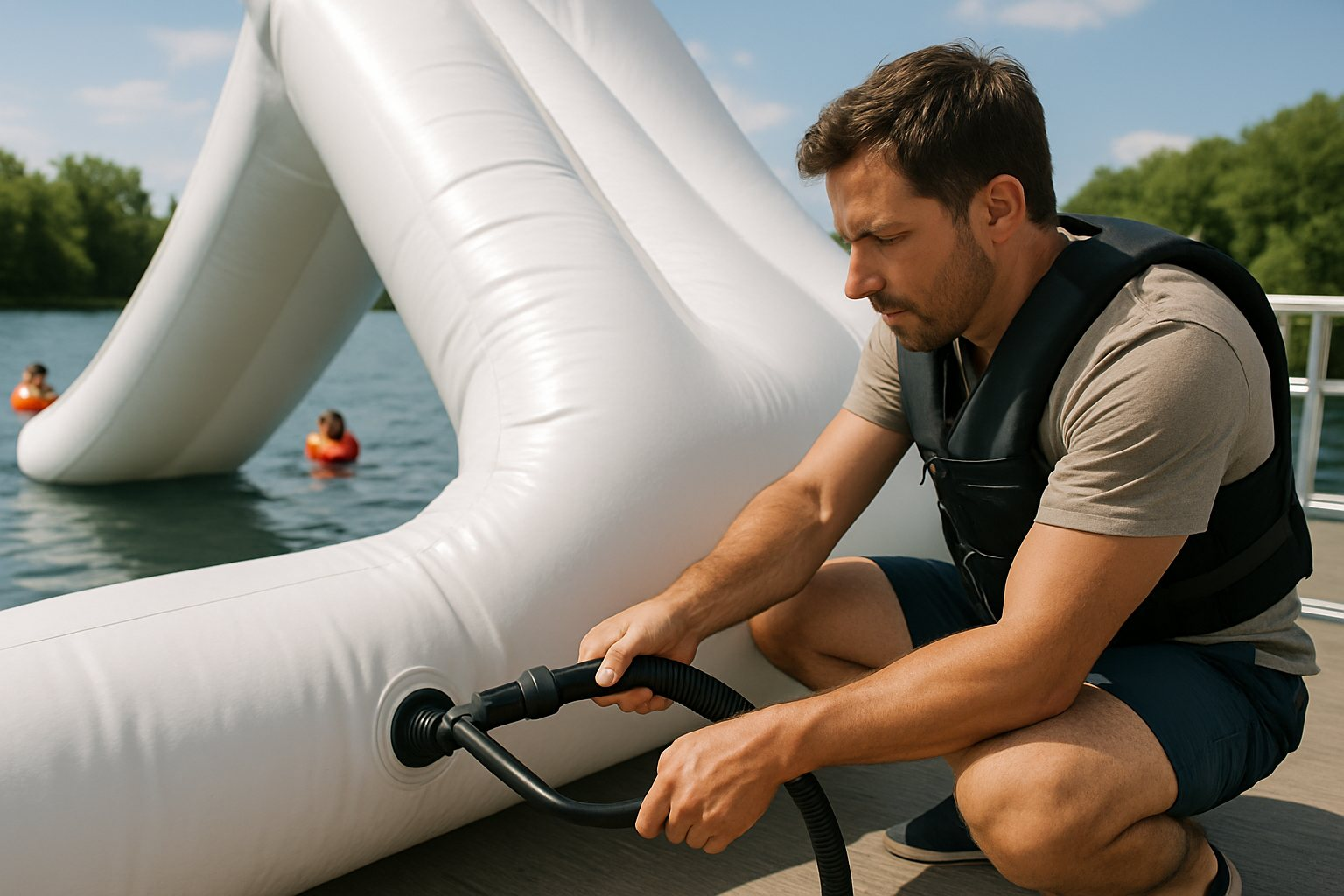
The anchor’s set, the kids are already in their life jackets, and all that stands between them and the first run is a flat roll of PVC on the deck. This is the moment a good boat slide pump earns its keep: five minutes of humming and the slide is firm, or twenty minutes of sweaty hand-pumping while everyone waits. This guide explains which pump each kind of slide needs, how to inflate a pontoon slide the way makers describe it, and the pressure limits you shouldn’t cross.
In short: tube-style pontoon slides need lots of air at low pressure: RAVE includes a 12 V inflator that runs off the boat battery, and its manual says never exceed 2 psi with compressed air. Drop-stitch slides like Slide Island need a high-pressure pump to reach 5 to 10 psi. Yacht slides come with the maker’s own electric pumps or blowers. Check whether a pump is in the box before you buy: the Airhead Spillway’s listing doesn’t include one.
Two kinds of slide, two kinds of boat slide pump
Most pontoon slides are big round tubes: the RAVE Pontoon Slide, the Airhead Spillway and the O’Brien Pontoon Slide. They hold a lot of air but only need to be “firm,” so the best tool is a high-volume electric inflator, the same kind used for towable tubes. Drop-stitch slides are different. Lakesurf’s Slide Island and Paddle North’s Slide are flat panels held together inside by thousands of threads, and they only go rigid at higher pressure: at least 5 psi and up to 10 psi, the range paddle-board pumps are built for. A towable-tube pump such as Airhead’s high-pressure model, which stops filling at 1.4 psi, won’t get there. Matching the pump to the slide is most of the job.
What each maker includes and recommends
| Slide | Pump in the box | Valve | Pressure the maker gives | Inflation time stated |
|---|---|---|---|---|
| RAVE Pontoon Slide | 12 V inflator/deflator, clips to the boat battery, plus a locking inflation adaptor | Main valve with a quarter-turn adaptor; plug on the side rails | Inflate “until it is firm”; do not exceed 2 psi with compressed air | About 5 minutes |
| Airhead Spillway | Not listed | High-pressure adapter valve, Halkey Roberts type | Not published | Inflate and attach in 5 minutes or less |
| O’Brien Pontoon Slide | Not stated in the listing we read | Not stated | Not published | Not stated |
| Lakesurf Slide Island (drop-stitch) | Dual-action hand pump | High-pressure Halkey-Roberts | At least 5 psi, no more than 10 psi | Not stated |
| Paddle North Slide (drop-stitch) | Sold separately; manual or electric pumps both work | Fill valve plus a pressure relief valve | 5 to 10 psi; 10 psi maximum | About 5 to 10 minutes |
| FunAir yacht slides | RapidFlate blower “when appropriate” and a FunAir electric pump | Maker’s own | Not published | Under 15 minutes (smallest models) to about 60 minutes (Riser) |
| Yachtbeach Magic Yachtslide 4.6 | Uses an electric pump | 4 high-pressure valves plus a pressure-release valve | Not published | About 10 to 15 minutes |
Superyacht Tenders & Toys builds its slides with several valves so up to three pumps can run at once, and FreeStyle lists two pumps and two venturi guns in the box with its Cruiser XS. On big yacht slides, the pump is part of the system: use what the maker supplies.
How to inflate a pontoon slide, step by step
RAVE’s owner’s manual gives the clearest routine for a tube-style pontoon slide. Adapted to the order you’ll do it on the water:
- Anchor first. RAVE asks for the boat to be securely anchored in at least 8 ft of water before you start, with the slide placed over the locked side gate.
- Connect the pump to the battery safely. Red clip to the positive terminal, black to the negative, one clip at a time, with dry hands. RAVE warns of sparks or shock.
- Fill the side rails first with the skinny nozzle, then moisten the plug and push it in flush.
- Fill the main chamber. Lock the inflation adaptor onto the hose, push it into the valve and turn a quarter turn. The adaptor opens the valve as it goes in and closes it as it comes out.
- Stop at firm. Properly inflated, RAVE says, the slide won’t buckle in use. Don’t use an air compressor: RAVE says over-inflation can rupture the tube beyond repair and void the warranty.
- Strap it on and check it can’t rock. Our guide on how to attach a boat slide covers the straps.
Inflating a drop-stitch slide
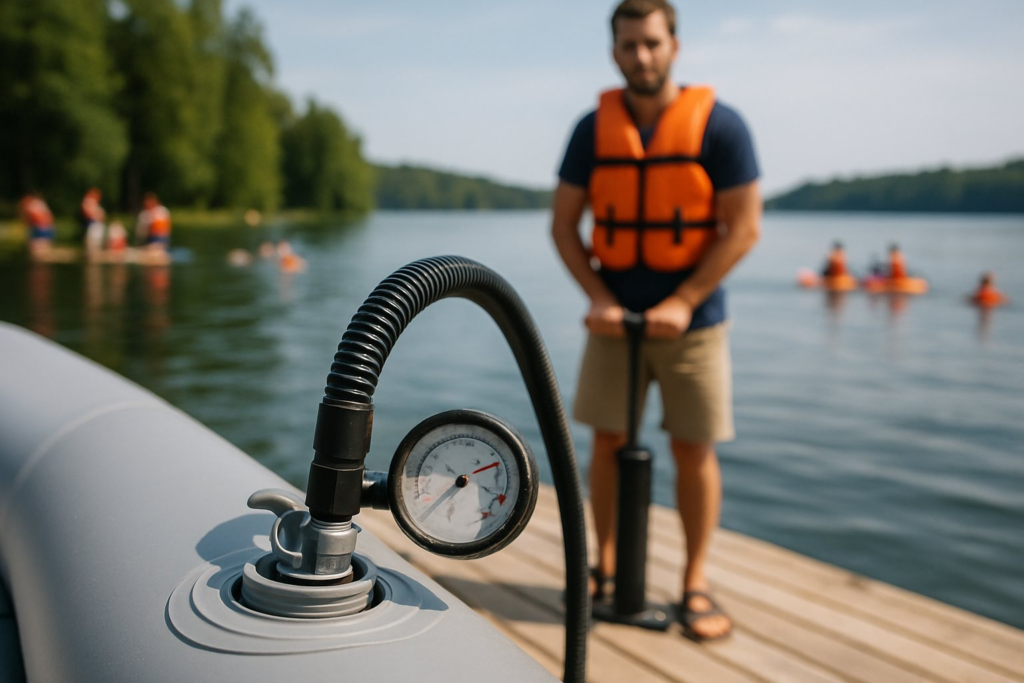
Lakesurf’s manual for Slide Island shows the high-pressure method. Twist off the valve cap, fully extend the valve stem (press it in and twist counter-clockwise), push the pump hose adapter in and twist it a quarter turn clockwise. Pump on the dual-action setting until it gets hard, around 5 psi, then switch the lever to single action and keep going to the pressure you want, never above 10 psi. In slide mode, Lakesurf asks for at least 5 psi. Paddle North gives the same 5 to 10 psi window for its Slide and fits a pressure regulator that lets air out if you reach the maximum. A pump with a gauge, or an electric pump with an auto-stop setting, makes this a lot easier.
Pumps worth having on board
Prices change often. The prices below are what we saw on Amazon in October 2026; check the current price before you buy. Always check that a pump’s adapters fit your slide’s valve and that its pressure suits your slide.
Airhead High Pressure Air Pump (12 V)
- 410 L/min, battery clips
- Pressure release at 1.4 psi
- About $72
Airhead AHP-12H 12 V Air Pump
- 290 L/min
- 12 V accessory plug
- About $24
RAVE Sports Pontoon Slide
- 12 V inflator/deflator in the box
- 200 lb, 1 rider
- About $320
The Airhead High Pressure Air Pump is a towable-tube pump: Airhead lists 410 liters a minute, alligator clips on a 10 ft cord, a removable pressure release valve that stops it filling past 1.4 psi, adapters for several valve types including Halkey Roberts and a 28 amp draw. The smaller AHP-12H plugs into a 12 V accessory socket and moves 290 liters a minute. Neither is meant for drop-stitch pressures; for Slide Island or Paddle North’s Slide, use the hand pump in the box or a paddle-board pump that reaches 10 psi.
Hot days, deflating and packing up
Air expands as it warms. RAVE notes that pressure rises and falls with air and water temperature and says that on very hot days you may need to check and let some air out during the day. Lakesurf says the same: on hot, sunny days release a little air to protect the valve and seams. When you’re done, RAVE has you loosen the straps, move the hose to the pump’s deflation port and empty the slide, then make sure it’s completely dry before rolling it up. Disconnect the pump from the battery afterwards. For drop-stitch slides, Lakesurf locks the valve open and has you fold the slide and press the air out with your body weight. Storage tips are in yacht slide storage and care and the older boat slide maintenance tips.
If a slide won’t stay firm, check the valves are fully closed before hunting for a hole; RAVE puts that first in its troubleshooting list. Our boat slide repair guide covers finding and patching leaks. All pontoon slide guides live under inflatable boat slides, and the best pontoon boat slides guide notes which ones include a pump.
Boat slide pump questions
Does a pontoon slide come with a pump?
It depends on the slide. RAVE includes a 12 V inflator/deflator and Slide Island includes a hand pump. Airhead’s Spillway listing doesn’t include a pump, and Paddle North sells its pump separately. Check the “in the box” list before you order.
How much PSI does a boat slide need?
Tube-style slides are inflated until firm, and RAVE says not to exceed 2 psi with compressed air. Drop-stitch slides need 5 to 10 psi (Lakesurf and Paddle North). Airhead doesn’t publish a pressure for the Spillway. Always use the number for your model.
Can I use an air compressor to inflate a pontoon slide?
RAVE says no: using an air compressor or over-inflating can rupture the tube beyond repair and void the warranty. Use the inflator the maker supplies or one with a pressure limit.
How long does it take to inflate a pontoon slide?
RAVE and Airhead both say about 5 minutes for their pontoon slides. Paddle North gives 5 to 10 minutes for its drop-stitch Slide. Yacht slides range from under 15 minutes to about an hour, depending on size.
Which valve does my slide have?
The Spillway’s valve is Halkey Roberts type, and Slide Island uses a high-pressure Halkey-Roberts valve. RAVE supplies its own locking adaptor. Check your manual; the words “Halkey Roberts” or “H-R” tell you which pump adapter to use.